












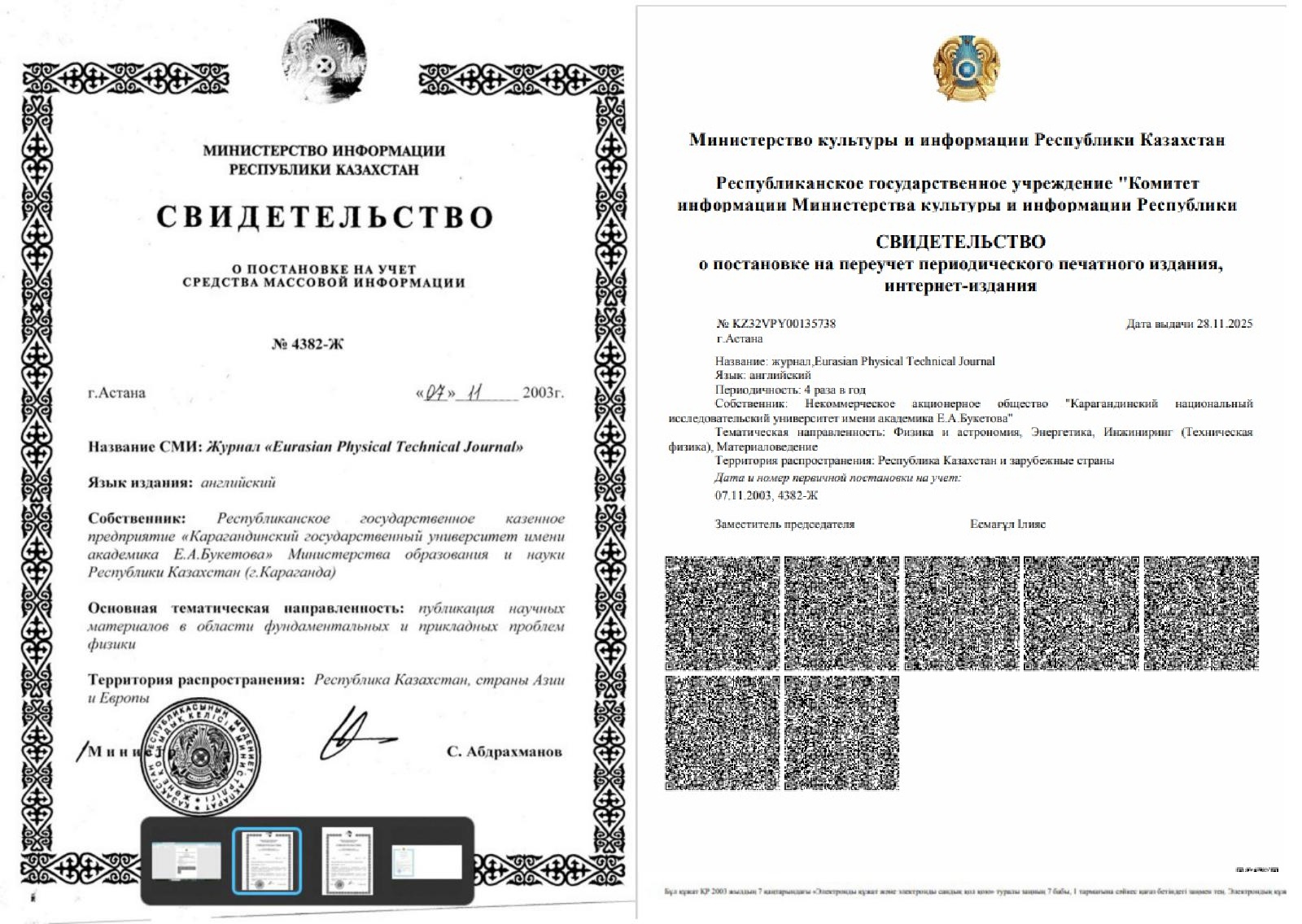
Certificates of registration and re-registration
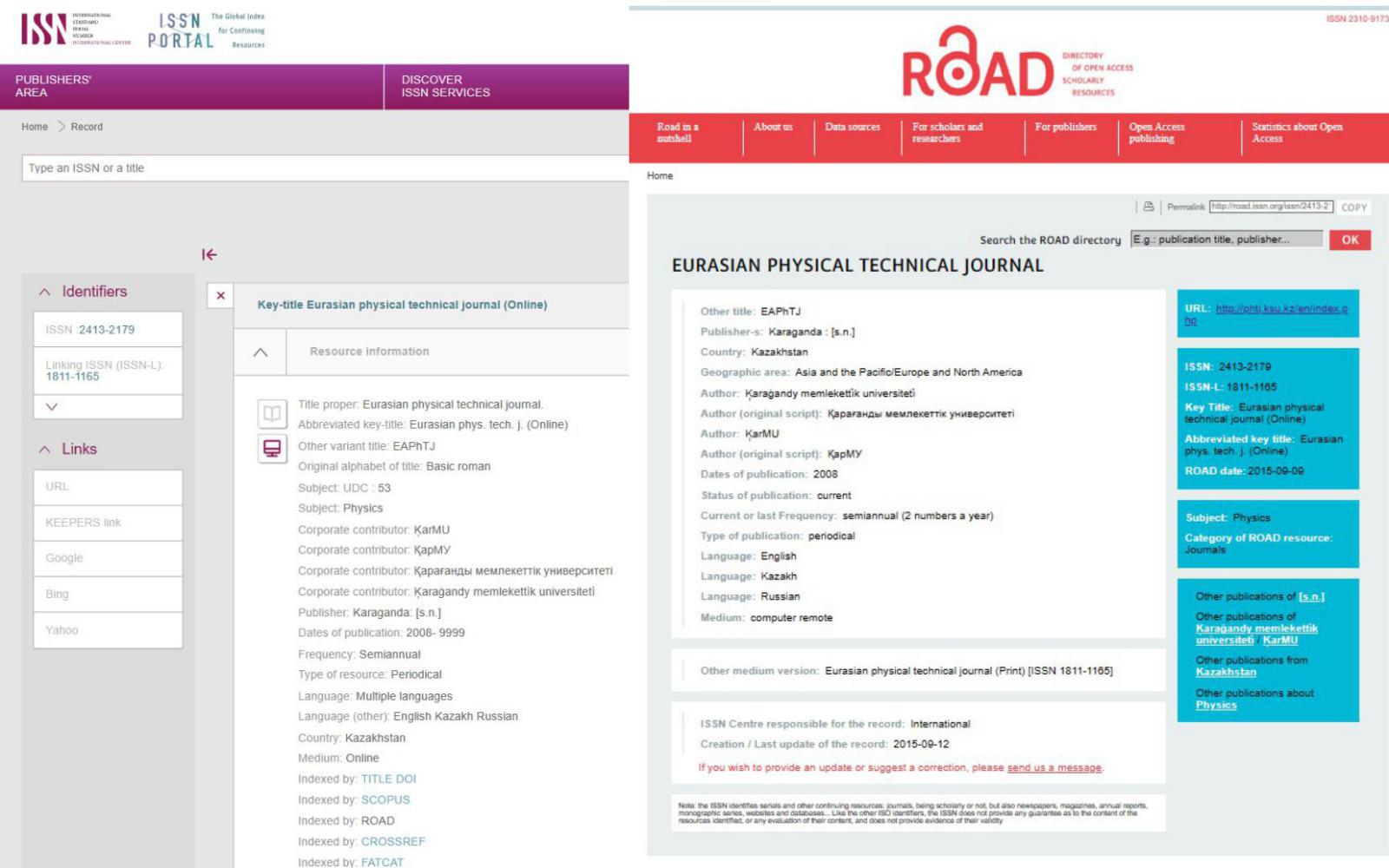
Confirmation of ISSN and Open Access status
Confirmation of indexing in the SCOPUS database
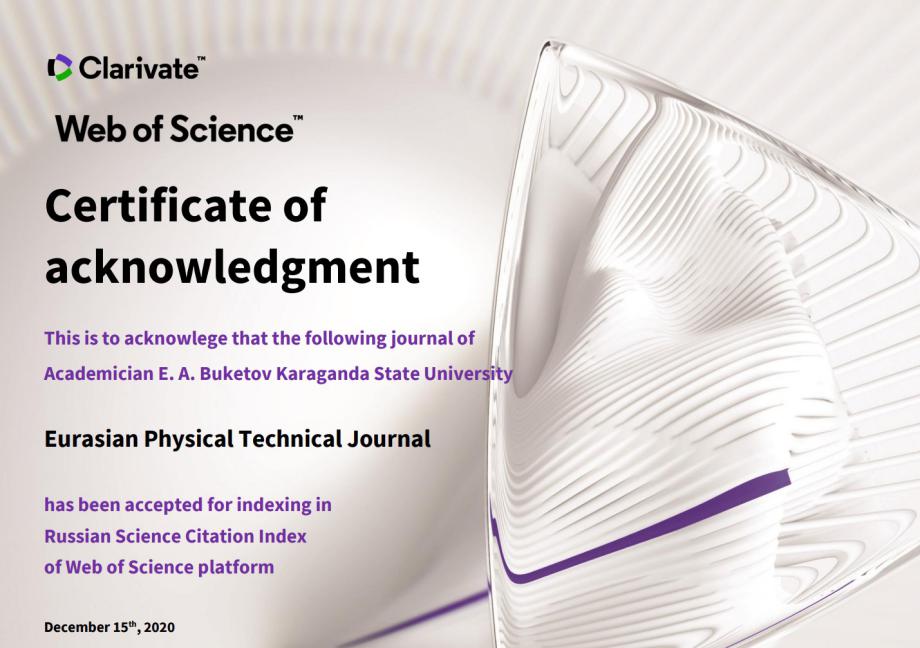
WoS Certificate of RCSI Indexing
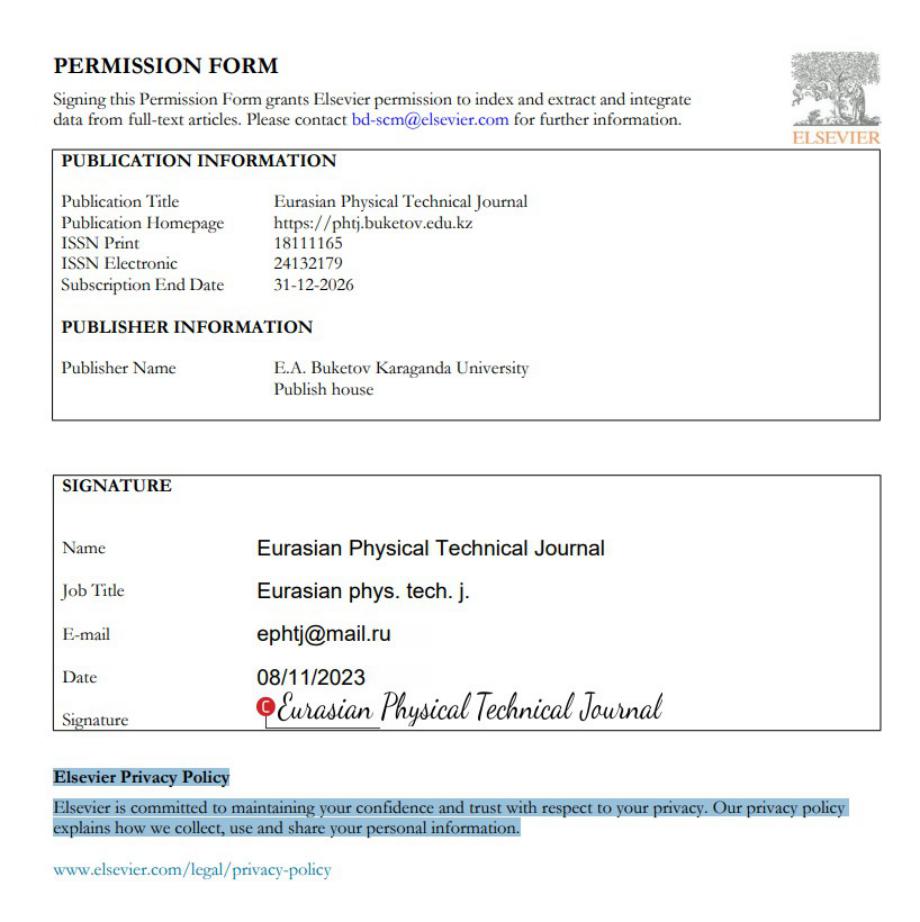
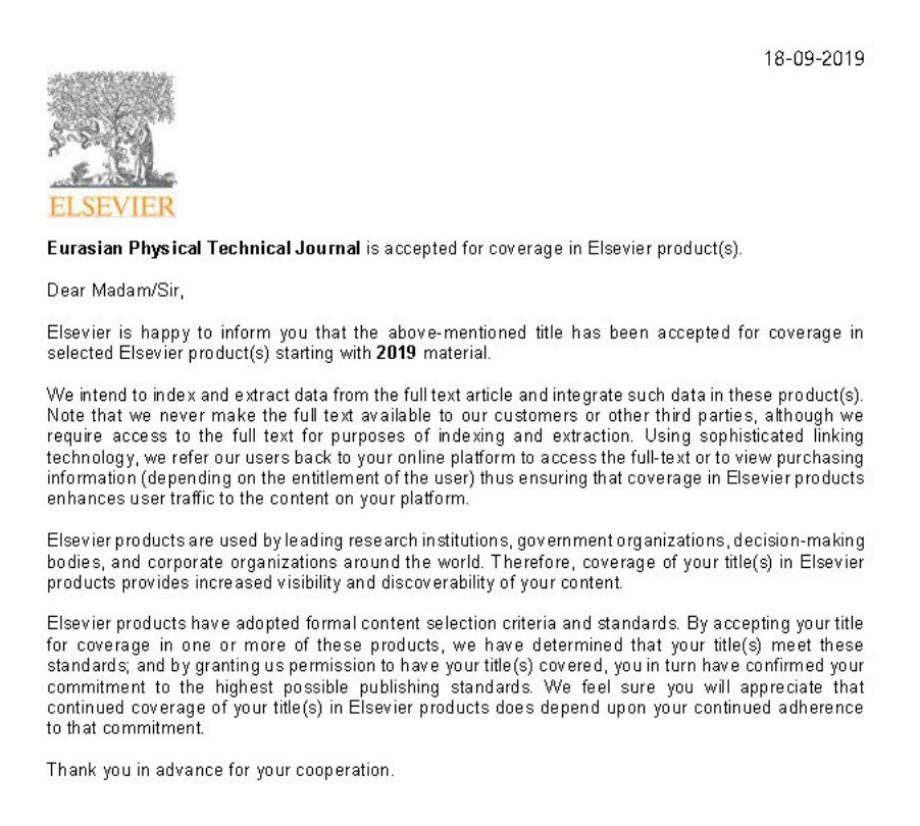
Elsevier permission
Manuscripts of scientific articles received by the editorial board of the Eurasian Physical Technical Journal and meeting the formal requirements for design, with originality of material of 75% or higher based on the results of checking through the plagiarism system, are sent for review.
1. Each manuscript of a scientific article submitted to the Eurasian Physical Technical Journal undergoes a single-blind peer review process, in which reviewers are aware of the authors’ identities, while authors do not know the reviewers. Each manuscript is evaluated by a minimum of two independent reviewers, selected from among leading domestic and international experts in the relevant field. The decision to select a specific reviewer for an article is made by the Editor-in-Chief in conjunction with the Section Editors-in-chief.
When preparing Special Issues, reviewers may be appointed by the Guest Editor after preliminary agreement of the reviewer's candidacy with the Editor-in-Chief.
2. The reviewing period is 2-4 weeks, but at the request of the reviewer it can be extended. The decision-making process for recommending an article for publication in a journal typically takes between 1 and 6 months. This includes the initial review of the manuscript, selection of reviewers, review preparation, author revision, re-review, and engagement of additional experts.
3. If the author(s) of a manuscript has a conflict of interest with other scientists, they should promptly disclose such conflict of interest in the Сover letter. Authors (corresponding author) can now also indicate "unwanted" reviewers when submitting a manuscript. The editor may or may not use this information, but such suggestions are welcome as they help ensure objective review.
4. The reviewer has the right to refuse to review in the event of an obvious conflict of interest that affects the perception and interpretation of the manuscript materials.
5. Each submission is assigned to the Section Editor-in-Chief responsible for the relevant subject area (Physics and Astronomy, Engineering, Energy, Materials Science]). At least two external reviewers who are not members of the Editorial Board and have no conflict of interest with the authors are selected. The Editor-in-Chief oversees the overall editorial process and resolves disputes.
6. Each manuscript is sent for evaluation to two experts with scientific specialization in the subject of the manuscript under review. The reviewer provides a clear, objective and reasoned assessment of the manuscript's compliance with the main scientific criteria and the quality and significance of its content. Based on the reviewing results, the reviewer is expected to present the editorial board with one of the following recommendations:
- to accept the paper in its present state;
- to invited the author to revise their manuscript to address specific concerns before final decision is reached;
- that final decision be reached following further reviewing by another specialist;
- to reject the manuscript outright.
7. If the reviewer has recommended any refinements, the editor would suggest the author either to implement the corrections, or to dispute them reasonably. Authors are asked to limit the revision period to two months from the moment the author is notified about the need for changes and resubmit the adapted manuscript within this period for re-assessment. The revised article may be sent back for re-consideration.
8. If irresolvable disagreements arise between the author and reviewers regarding the manuscript, as in other conflict situations, the decision is made by the editor-in-chief, who has the right to send the manuscript for additional review by a third expert.
9. If the authors refuse to revise the materials, they must notify the editors in writing or orally of their refusal to publish the article. If the authors do not return the revised version after 3 months from the date of sending the review, even in the absence of information from the authors refusing to revise the article, the article is removed from the register. In such situations, the authors are sent an appropriate notification of the removal of the manuscript from registration from site due to the expiration of the time allotted for revision.
10. The decision to reject a manuscript is made based on the results of the review. In case of receiving two negative reviews, the manuscript is rejected from publication in the journal and is not accepted for reconsideration. Materials of articles rejected by the editorial board based on the results of the review are not used by the editorial board for its own purposes. The editor sends a message from the OJS website of the journal, in which he/she notifies the authors or the corresponding author of the rejection of the manuscript.
11. A positive review is not sufficient grounds for publishing an article. After the decision to accept an article for publication is made, the editor informs the corresponding author of this, indicating the publication dates and terms of payment for publication depending on the status of the co-authors. The final decision on publishing the manuscript is made at a meeting of the editorial board.
12. Reviews of manuscripts are stored for three years in electronic format on the journal's electronic platform. The editor of the journal sends copies of reviews to the Committee of the Ministry of Science and Education of the Republic of Kazakhstan upon receipt of a corresponding request by the editorial office.
Certificates of registration and re-registration
Confirmation of ISSN and Open Access status
Confirmation of indexing in the SCOPUS database
WoS Certificate of RCSI Indexing
Elsevier permission