









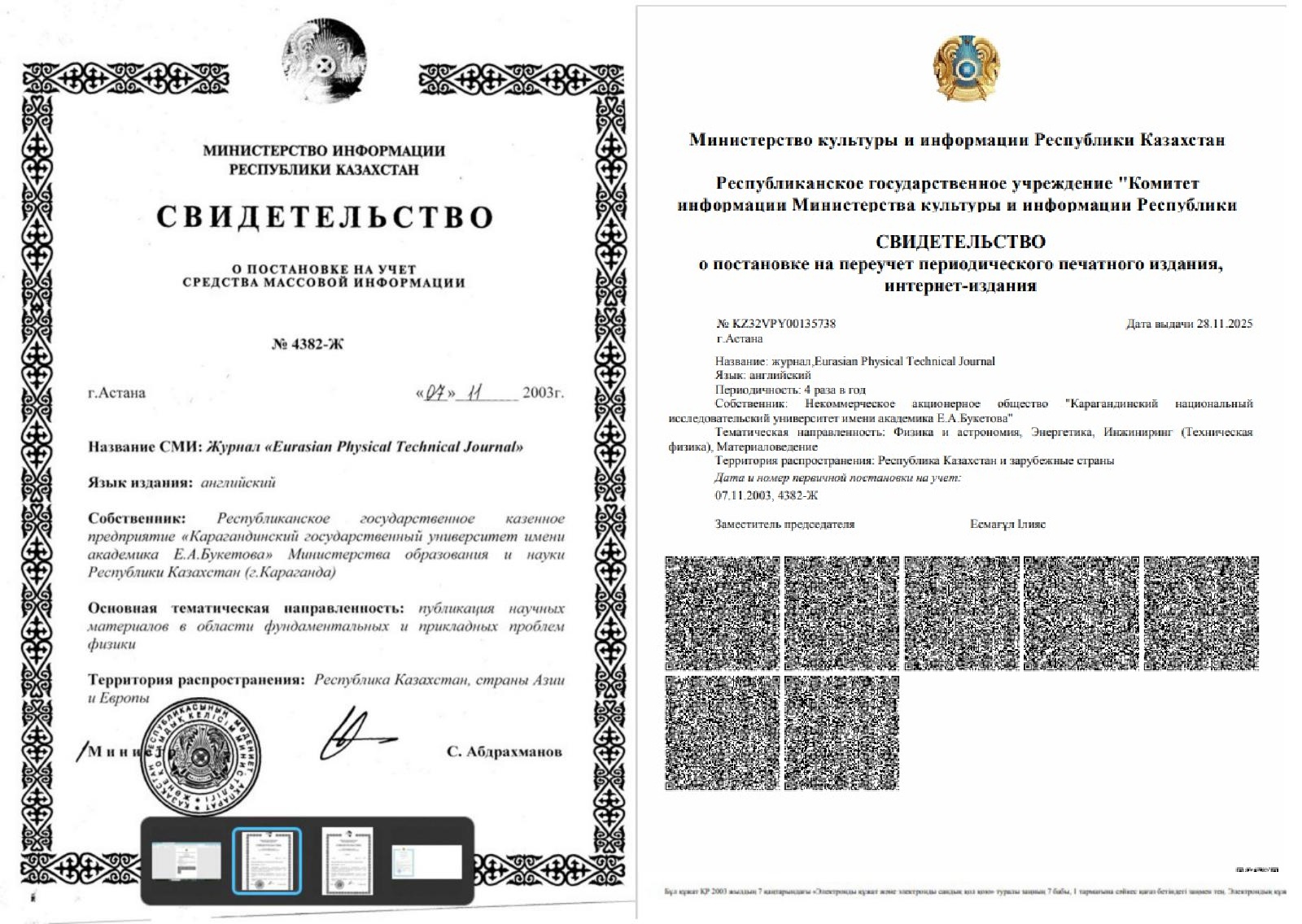
Certificates of registration and re-registration
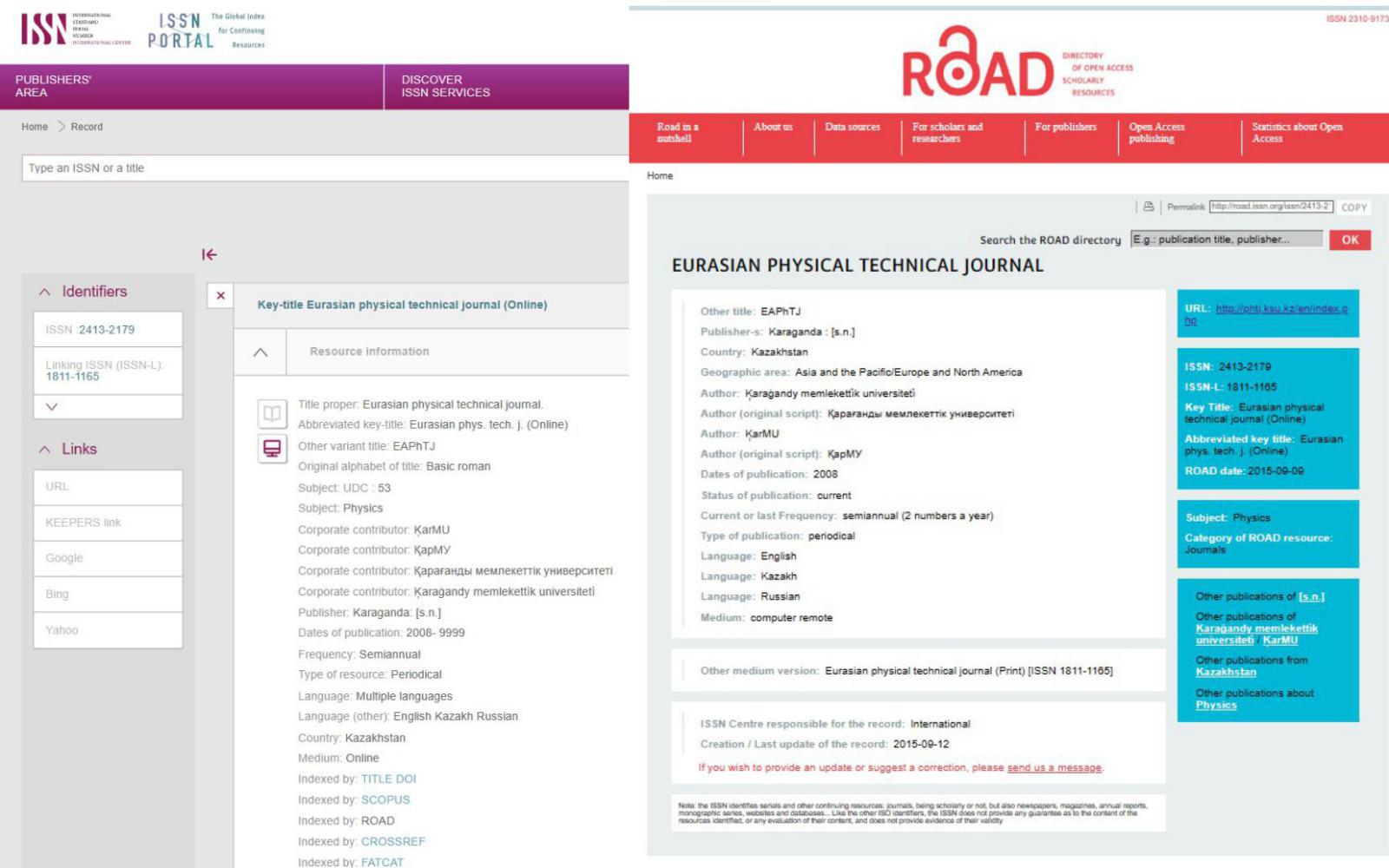
Confirmation of ISSN and Open Access status
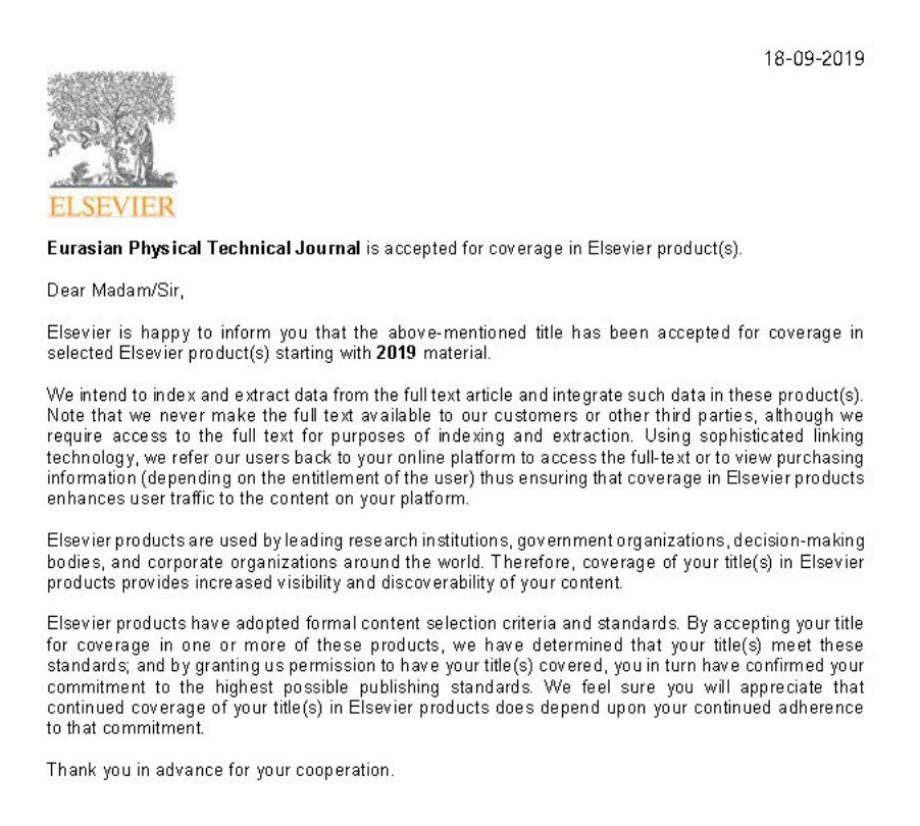
Confirmation of indexing in the SCOPUS database
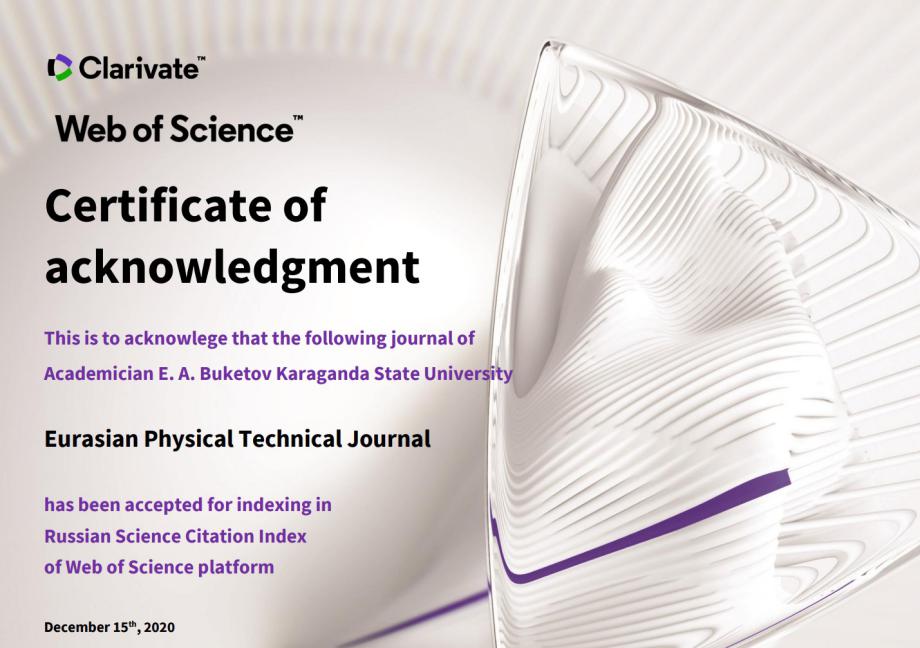
WoS Certificate of RCSI Indexing
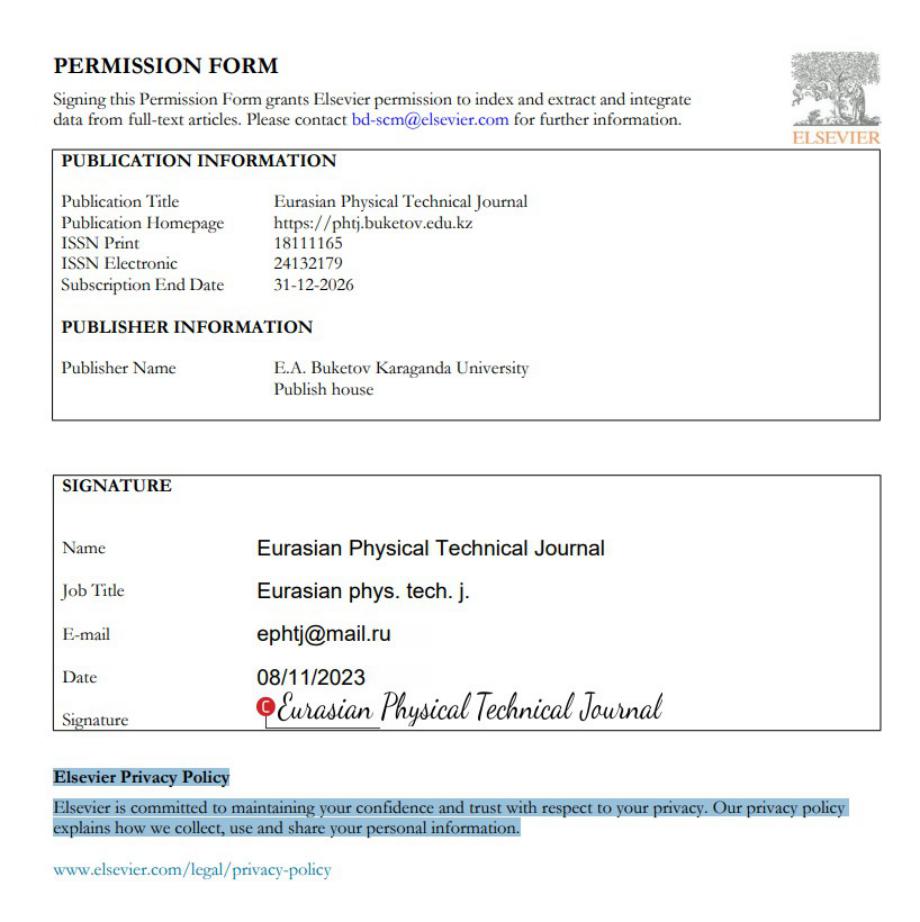
Elsevier permission
The “Eurasian phys. tech. j.” scientific edition is committed to adhere closely with the ethical guidelines set by various international organizations i.e. Committee on Publication Ethics (COPE), International Committee of Medical Journal Editors (ICJME) and maintain the high standards of publication process set standards and provide guidelines for best practices in order to meet these requirements.
The “Eurasian phys. tech. j.” editors are responsible for deciding which of the articles submitted to the journal should be published. In evaluating the submitted works, the editors should limit themselves only to the intellectual scientific content. The editors can choose to ignore any material that breaks legal requirements regarding libel, copyright infringement and plagiarism.
The Editors must ensure the confidentiality of the submitted works until they are published. The publication of an article in a peer-reviewed journal is an essential building block in the development of a logical and valued network of knowledge. It is a direct indication of the quality of the work of the authors and the institutions that support them. Peer-reviewed articles support and exemplify the scientific method and solution. It is therefore important to agree upon standards of expected ethical behavior for all parties involved in the act of publishing: the author, the journal editor, the peer reviewer, the publisher and the society.
These guidelines are based on existing COPE Best Practice Guidelines for Journal Editors.
The Editor-in-Chief in conjunction with the Section Editors are responsible for deciding which of the articles submitted to the journal should be published. The corroboration of the work in question and its importance to researchers and readers must always drive such decisions. The editors may be guided by the policies of the journal's editorial board and constrained by such legal requirements as shall then be in force regarding libel, copyright infringement and plagiarism.
An editor should evaluate manuscripts for their intellectual content without regard to race, gender, sexual orientation, religious belief, ethnic origin, citizenship, or political philosophy of the authors.
The editor and any editorial staff must not disclose any information about a submitted manuscript to anyone other than the corresponding author, reviewers, potential reviewers, other editorial advisers, and the publisher, as appropriate.
Unpublished materials disclosed in a submitted manuscript must not be used in an editor's own research without the express written consent of the author. Privileged information or ideas obtained through peer review must be kept confidential and not used for personal advantage. Editors should recuse themselves (i.e. should ask a co-editor, associate editor or other member of the editorial board instead to review and consider) from considering manuscripts in which they have conflicts of interest resulting from competitive, collaborative, or other relationships or connections with any of the authors, companies, or (possibly) institutions connected to the papers. Editors should require all contributors to disclose relevant competing interests and publish corrections if competing interests are revealed after publication. If needed, other appropriate action should be taken, such as the publication of a retraction or expression of concern.
This section has been compiled in accordance with the principles of the Committee on Publication Ethics (COPE – https://publicationethics.org/resources).
Authors of scientific work of original research should present an accurate account of the work performed as well as an objective discussion of its significance. Underlying data should be represented correctly in the paper. A paper should contain sufficient detail and references to permit others to replicate the work. Counterfeit or knowingly inaccurate statements constitute unethical behavior and are unacceptable.
The authors should ensure that they have written entirely original works, and if the authors have used the work and/or words of others that this has been appropriately cited or quoted. Plagiarism takes many forms, from publishing of another ‘s paper as the author ‘s own paper, to copying or paraphrasing substantial parts of another ‘s paper (without acknowledgment), to claiming results from research conducted by others. Plagiarism in all its forms constitutes unethical publishing behavior and is unacceptable. Manuscripts are checked to detect borrowings using software Strikeplagiarism.com, Oysyn and Antiplagiat.ru. When plagiarism is detected, COPE guidelines are followed.
Plagiarism in all its forms is unacceptable and will lead to the immediate rejection of the article along with possible sanctions against the authors. The authors of an article in which a provable fact of plagiarism was discovered are not allowed to submit articles to the journal for the next 3 years.
A published article may be retracted if errors are discovered that significantly affect the reliability or validity of the presented results, and if such problems cannot be adequately addressed by publishing a correction or clarification, details are in Retraction.
An author should not in general publish manuscripts describing essentially the same research in more than one journal or primary publication. Submitting the same manuscript to more than one journal concurrently constitutes unethical publishing behavior and is intolerable. In general, an author should not submit for consideration in another journal a previously published paper.
Proper acknowledgment of the work of others must always be given. Authors should cite publications that have been significant in determining the nature of the reported work. Information obtained privately, as in conversation, correspondence, or discussion with third parties, must not be used or reported without explicit, written permission from the source. Information obtained in the course of confidential services, such as refereeing manuscripts or grant applications, must not be used without the explicit written permission of the author of the work involved in these services.
Authorship should be limited to those who have made a significant contribution to the conception, design, execution, or interpretation of the reported study. All those who have made significant contributions should be listed as co-authors. Where there are others who have participated in certain substantive aspects of the research project, they should be acknowledged or listed as contributors. The corresponding author should follow the "Guide for authors" and objectively describe the "CRediT Roles" of each co-author in the " CRediT author statement". The corresponding author should ensure that all appropriate co-authors and no inappropriate co-authors are included on the paper, and that all co-authors have seen and approved the final version of the paper and have agreed to its submission for publication.
If the work involves chemicals, procedures or equipment that have any unusual hazards inherent in their use, the author must clearly identify these in the manuscript. If the work involves the use of animal or human subjects, the author should ensure that the manuscript contains a statement that all procedures were performed in compliance with relevant laws and institutional guidelines and that the appropriate institutional committees has approved them. Authors should include a statement in the manuscript that informed consent was obtained for experimentation with human subjects. The privacy rights of human subjects must always be observed.
All authors should disclose in their manuscript any financial or other substantive conflict of interest that might be construed to influence the results or interpretation of their manuscript. All sources of financial support for the project should be disclosed. In the "Conflict of interest statement" the authors declare that they have no conflict of interest in relation to this research, whether financial, personal, authorship or otherwise, that could affect the research and its results presented in this paper. This declaration of absence of conflict of interest must be confirmed in a cover letter from the university, research institute, or organization licensed to conduct research. This cover letter must be on official letterhead and/or bear the organization's seal. By Cover letter, the organization's management confirms that the article materials (the article title and the authors' names must be written in English), based on the authors' research results, do not contain information constituting a state or commercial secret, and that the article may be published in an Open Access publication.
When an author discovers a significant error or inaccuracy in his/her own published work, it is the author‘s obligation to promptly notify the journal editor or publisher and cooperate with the editor to retract or correct the paper. If the editor or the publisher learns from a third party that a published work contains a significant error, it is the obligation of the author to promptly retract or correct the paper or provide evidence to the editor of the correctness of the original paper.
Reviewers play a key role in maintaining the scientific quality and integrity of the journal. Their evaluations support the editorial decision-making process and contribute to the improvement of submitted manuscripts.
All manuscripts received for review must be treated as confidential documents. Information obtained during the review process must not be disclosed or used for personal advantage.
Reviews should be conducted objectively and professionally. Personal criticism of the authors is inappropriate. Comments should be clear, constructive, and supported by reasoned arguments.
Reviewers should ensure that relevant published work has been properly cited and that sources of data are appropriately acknowledged.
Reviewers should inform the editor if they identify substantial similarity with previously published work, possible plagiarism, data fabrication, or other ethical concerns.
Reviewers are encouraged to identify important relevant publications that have not been cited by the authors.
Reviewers must decline to review manuscripts in which they have conflicts of interest arising from competitive, collaborative, or other relationships with the authors, institutions, or related organizations.
Reviewers should complete their evaluations within the agreed timeframe. If this is not possible, they should promptly inform the editorial office so that alternative reviewers can be assigned.
The Journal adheres to the principles of transparency, integrity, and accuracy of the scholarly record, in accordance with the guidelines of the Committee on Publication Ethics (COPE). The Journal ensures timely and appropriate correction of errors in published articles. Corrections are issued only when errors do not compromise the scientific validity or main conclusions of the work.
1. Grounds for Corrections. Corrections may be issued for:
2. Types of Corrections. The Journal recognizes:
3. Submission of Correction Requests. Requests for correction must include:
4. Editorial Assessment and Decision. The Editorial Office evaluates each request and may involve reviewers if necessary. Based on the assessment, the Journal may issue a correction, an Expression of Concern, or, in serious cases, a retraction.
5. Preparation and Publication. Corrections are published as separate documents and must include:
Each correction receives a unique DOI and is electronically linked to the original article.
6. Indexing and Transparency. All corrections are indexed and linked to the original publication, ensuring transparency in line with COPE principles.
7. Limitations. Corrections are not used to introduce new findings, substantially alter interpretations, or address cases requiring retraction.
Retraction of a published article is considered a measure of last resort and is undertaken only after all reasonable alternatives for correcting the scholarly record have been carefully evaluated.
An article may be retracted where errors are identified that significantly affect the reliability or validity of the reported findings, and where such issues cannot be adequately addressed by the publication of a correction or erratum.
The purpose of retraction is to maintain the integrity of the scholarly record and to alert readers to publications containing unreliable or invalid data or conclusions. Retraction is not intended as a punitive measure against authors.
The decision is made by the Editor-in-Chief and the Editorial Ethics Committee members of the Eurasian Physical Technical Journal taking into account all relevant evidence and circumstances. Investigations are conducted as efficiently as possible, taking into account the complexity of the case and the availability of relevant evidence.
Where authors request a retraction, they must ensure that all co-authors have been informed and provide the Editor with a clear and reasoned explanation for the request. Where retraction is initiated by the editorial office or a third party, the authors will be informed and given an opportunity to respond before a final decision is made.
The Eurasian Physical Technical Journal follows the recommendations of the Committee on Publication Ethics (COPE) for all retraction decisions.
Reasons and Criteria for Retraction
A retraction may be issued under the following circumstances:
Retraction Process
Expression of Concern
In cases where an investigation is ongoing and a final decision has not yet been reached, the journal may publish an Expression of Concern to alert readers to potential issues with the reliability of the reported findings.
An Expression of Concern may be issued when:
The Expression of Concern is assigned a DOI and linked to the original article. Upon conclusion of the investigation, it will be either replaced by a Retraction Notice or withdrawn if the authors are cleared.
Complete Removal of an Article
In exceptional circumstances, an article may be completely removed from the Eurasian Physical Technical Journal website and relevant indexing databases. Such removal may be considered only when:
In such cases, only the article metadata (title and authors) is retained, and the retraction notice explains why the full content has been removed.
Consequences
For the scholarly record: Retraction ensures the accuracy, transparency, and integrity of published research. The retracted article will be excluded from the journal's citation metrics but will remain accessible online for transparency.
For authors: Retraction may have reputational implications. However, where retraction results from an honest error, it is generally regarded as a responsible and ethical action.
Certificates of registration and re-registration
Confirmation of ISSN and Open Access status
Confirmation of indexing in the SCOPUS database
WoS Certificate of RCSI Indexing
Elsevier permission