INTELLIGENT DEVICE FOR DIAGNOSTICS AND FAILURE PREDICTION OF FIBER-OPTIC COMMUNICATION LINES BASED ON DIGITAL MONITORING
Authors

DOI:
https://doi.org/10.31489/2026N2/99-107Abstract
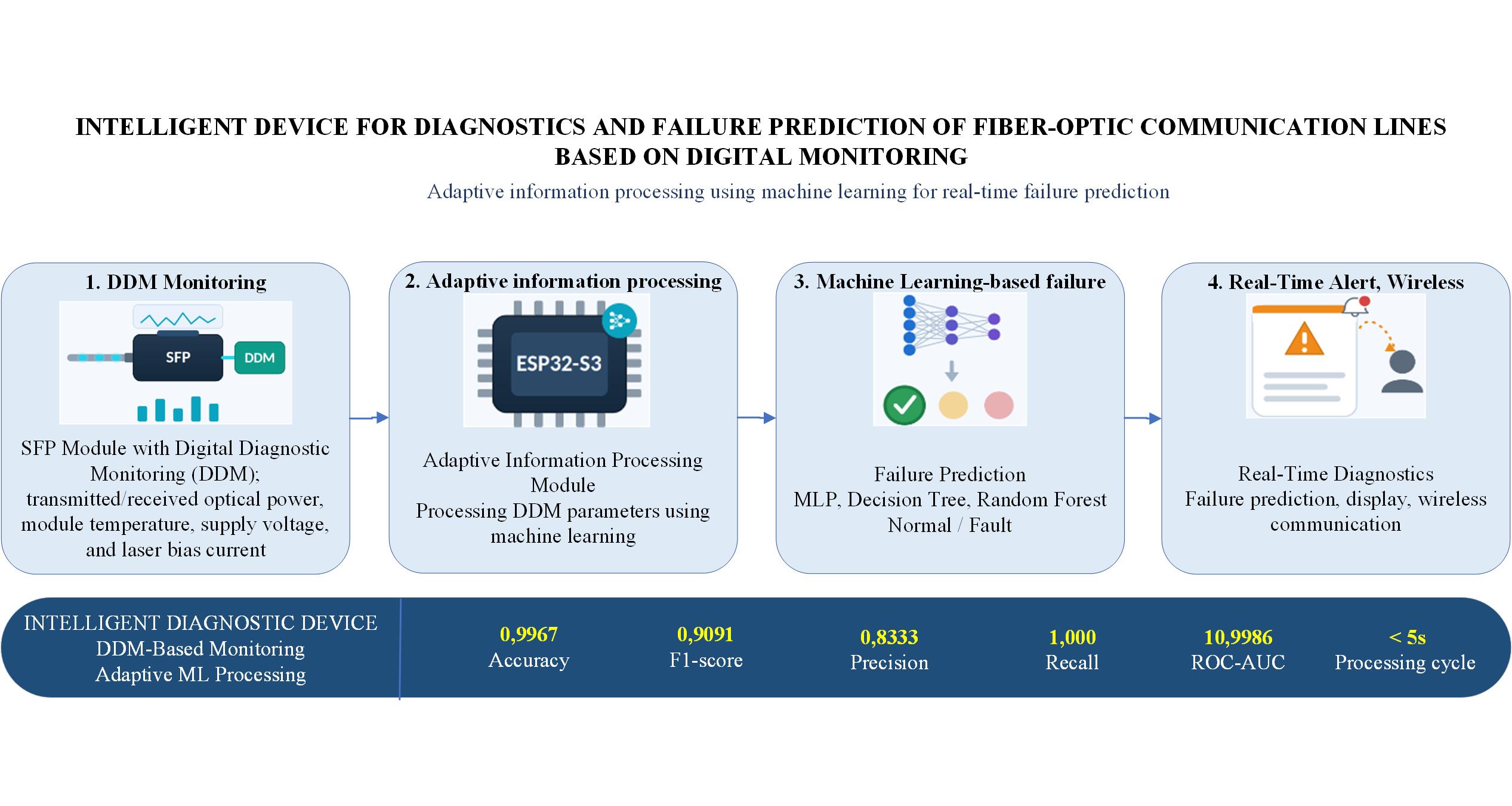
. In the context of intensive growth in the volume of transmitted information and the complexity of telecommunication network architecture, improving reliability of fiber-optic communication lines at the operational stage is becoming particularly relevant. This paper proposes an approach to intelligent diagnostics of fiber-optic information transmission system elements based on the parameters of digital monitoring of optical modules. The feasibility of using diagnostic data on the power of the optical signal, temperature, power voltage, and laser current to assess the current state of the line and identify signs of degradation is analyzed. A structural diagram of a hardware-software device is proposed, providing continuous data collection, their adaptive processing, and the formation of real-time prognostic estimates. For processing diagnostic parameters, a machine learning model adapted for the built-in microcontroller platform and focused on failure risk classification and intelligent diagnostics of line elements. The results of experimental studies based on real operational data confirm the possibility of early detection of potential failures and increasing the reliability of fiber-optic communication lines.
References
1. Winzer, P. J. (2023). The future of communications is massively parallel. Journal of Optical Communications and Networking, 15, 783–787. https://doi.org/10.1364/JOCN.496992 DOI: https://doi.org/10.1364/JOCN.496992
2. Statista. (2024). Number of internet users worldwide. https://www.statista.com/statistics/273018/number-of-internet-users-worldwide/
3. Davronbekov, D., Juraeva, N., & Boboev, A. (2024). Advanced applications of machine learning techniques in FOITS. In Proceedings of the 4th International Conference on Technological Advancements in Computational Sciences (ICTACS) (pp. 773–778). Tashkent, Uzbekistan. https://doi.org/10.1109/ICTACS62700.2024.10840715 DOI: https://doi.org/10.1109/ICTACS62700.2024.10840715
4. Juraeva, N., Davronbekov, D., & Turdiev, U. (2025). Predicting failures in fiber optic information transmission systems with support of machine learning. Revista Científica de Sistemas e Informática, 5(2), e907. https://doi.org/10.51252/rcsi.v5i2.907 DOI: https://doi.org/10.51252/rcsi.v5i2.907
5. Zhang, D., Du, Z., Cheng, M., Jiang, M., & Liu, X. (2023). Innovation and demonstration of a new CWDM and circulator integrated semi-active system for 5G fronthaul. Journal of Lightwave Technology, 41(4), 1223–1228. https://doi.org/10.1109/JLT.2022.3199470 DOI: https://doi.org/10.1109/JLT.2022.3199470
6. Notaro, P., Palermo, G., & Zanus, D. (2023). An optical transceiver reliability study based on SFP monitoring and OS-level metric data. In 2023 IEEE/ACM 23rd International Symposium on Cluster, Cloud and Internet Computing (CCGrid), (pp. 1–12). https://doi.org/10.1109/CCGrid57682.2023.00011 DOI: https://doi.org/10.1109/CCGrid57682.2023.00011
7. Nazarov, A. M., Rakhmonov, A. R., Khurbanbayev, S. Z., Mavlyanov, A. S., & Davronbekov, D. A. (2017). The device for diagnostics of optical fiber cables. European Journal of Technical and Natural Sciences, (5), 82–88. https://elibrary.ru/item.asp?id=32378796
8. Pregowska, A., Osial, M., et al. (2020). From mirrors to free-space optical communication. Future Internet, 12(11), Article 179. https://doi.org/10.3390/fi12110179 DOI: https://doi.org/10.3390/fi12110179
9. Jinlin, Z., et al. (2009). The application and realization of the digital diagnostic monitoring function for SFP optical transceiver module. In IEEE Conference Proceedings (pp. 379–382). https://doi.org/10.1109/ICBNMT.2009.5348515 DOI: https://doi.org/10.1109/ICBNMT.2009.5348515
10. China National Intellectual Property Administration. (2024). Optical module diagnostic system (Patent No. CN119766321A). https://patents.google.com/patent/CN119766321A/en
11. China National Intellectual Property Administration. (2024). Automatic optical power correction method (Patent No. CN118611744A). https://patents.google.com/patent/CN118611744A/en
12. Davronbekov, D. A., Juraeva, N. I., & Xamidov, X. A. (2025). Adaptiv axborotni qayta ishlash bilan optik tolali aloqa liniyalari elementlarini diagnostika qilish qurilmasi (Utility Model Patent No. FAP 2865). Ministry of Justice of the Republic of Uzbekistan. https://im.adliya.uz/register/UTILITY_MODEL?page=6
13. Espressif Systems. (2023). ESP32-WROOM-32E and ESP32-WROOM-32UE datasheet. https://www.espressif.com/sites/default/files/documentation/esp32-wroom-32e_esp32-wroom-32ue_datasheet_en.pdf
14. Espressif Systems. (2023). ESP32-S3-WROOM-2 datasheet. https://www.espressif.com/ sites/default/files/documentation/esp32-s3-wroom-2_datasheet_en.pdf
Downloads
Published online
How to Cite
Issue
Section
License

This work is licensed under a Creative Commons Attribution-NonCommercial-NoDerivatives 4.0 International License.