SPECTROSCOPY AND STRUCTURAL PROPERTIES OF HEAVY QUARKONIUM SYSTEMS
Authors
-
Jonathan Eyire Osang
 Dr. (Sci.), Department of Physics, University of Cross River State, Calabar, Nigeria
-
Etido Patrick Inyang
Dr. (Sci.), Department of Physics, Faculty of Science, National Open University of Nigeria, Abuja, Nigeria
-
Ndianabasi Henry Valentine
Dr. (Sci.), Department of Science Laboratory Technology, University of Calabar, Calabar, Nigeria
-
Samuel Eyeh Mopta
Dr. (Sci.), Department of Physics, Faculty of Physical Science, University of Calabar, Calabar, Nigeria
-
Eddy Sunday William
Dr. (Sci.), Department of Physics, School of Pure and Applied Sciences, Federal University of Technology, Ikot Abasi, Nigeria
-
Joseph Amajama
Dr. (Sci.), Department of Physics, Faculty of Physical Science, University of Calabar, Calabar, Nigeria
-
Christopher Chinasa Ekechukwu
Mr. (Sci.), Department of Physics, Faculty of Physical Science, University of Calabar, Calabar, Nigeria
DOI:
https://doi.org/10.31489/2026N3/126-138Keywords:
Heavy Mesons, Varshni–Hellmann Potential, Quark–antiquark interactions, Schrödinger Equation, Quarkonium SpectroscopyAbstract
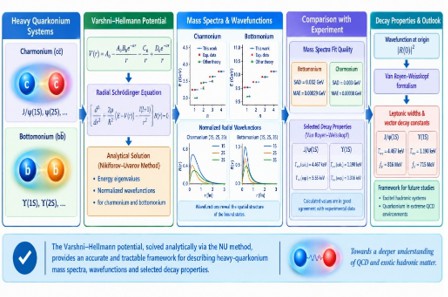
The spectroscopy and structural properties of heavy quarkonium systems are investigated within the Varshni–Hellmann potential model. The radial Schrödinger equation is solved analytically using the Nikiforov–Uvarov method to obtain the energy eigenvalues and normalized wavefunctions of charmonium and bottomonium states. The calculated mass spectra are compared with available experimental data and results from previous theoretical studies. The present model yields sum of absolute deviations (SADs) of 0.002 GeV and 0.003, with corresponding mean absolute errors of 0.00029 GeV and 0.00038 GeV for bottomonium and charmonium, respectively. The corresponding wavefunctions are examined to characterize the spatial structure of the bound states. In addition, the wavefunctions at the origin are used within the Van Royen–Weisskopf formalism to calculate the leptonic decay widths and vector decay constants of the J/ψ(1S) and Υ(1S) states. The calculated leptonic widths are 4.467 keV for J/ψ(1S) and 1.190 keV for Υ(1S)), compared with the experimental values of 5.55 keV and 1.340 keV, respectively. The results demonstrate that the Varshni–Hellmann potential provides an analytically tractable framework for describing heavy quarkonium mass spectra, wavefunctions, and selected decay properties. The framework may provide a basis for future investigations of exotic hadronic systems and quarkonium behaviour in extreme quantum chromodynamics environments.
References
1. Litvinov, A., & Meshcheriakov, P. (2025). Meson mass spectrum in QCD2 ’t Hooft's model. Nuclear Physics B, 1010, 116766. https://doi.org/10.1016/j.nuclphysb.2025.116766 DOI: https://doi.org/10.1016/j.nuclphysb.2024.116766
2. Inyang, E. P., Ali, N., Endut, R., Rusli, N., & Aljunid S.A. (2025). The radial scalar power potential and its application to quarkonium systems. Indian Journal of Physics, 99, 715–724. https://doi.org/10.1007/s12648-024-03335-9 DOI: https://doi.org/10.1007/s12648-024-03335-9
3.. Ali, M. S, Hassan, G. S., Abdelmonem, A. M., Elshamndy, S. K., Elmasry, F., & Yasser, A. M. (2020). The spectrum of charmed quarkonium in non-relativistic quark model using matrix Numerov’s method. Journal of Radiation Research and Applied Sciences, 13, 226–233. https://doi.org/10.1080/16878507.2020.1723949 DOI: https://doi.org/10.1080/16878507.2020.1723949
4. Inyang, E. P., Ali, N., Endut, R., Rusli, N., Aljunid, S. A., Ali, N. R., & Asjad M. M. (2024). Thermal properties and mass spectra of heavy mesons in the presence of a point-like defect. East European Journal of Physics, 1, 156–166. https://doi.org/10.26565/2312-4334-2024-1-14 DOI: https://doi.org/10.26565/2312-4334-2024-1-13
5. Matvienko, D. (2018). The Belle II experiment: Status and physics program. EPJ Web of Conferences, 191, 02010. https://doi.org/10.1051/epjconf/201819102010 DOI: https://doi.org/10.1051/epjconf/201819102010
6. Mistry, R., Shah, M., & Majethiya, A. (2024). Mass spectra, Regge trajectories and decay properties of heavy-flavour mesons. Revista Mexicana de Física, 70, 010801. https://doi.org/10.31349/RevMexFis.70.010801 DOI: https://doi.org/10.31349/RevMexFis.70.010801
7. Inyang, E. P., Nwachukwu, I. M., Ekechukwu, C. C., Ekong, I. B., William, E. S., Lawal, K. M., Momoh, K. O., & Oyelami, O. A. (2024). Analytical solution of the class of inversely quadratic Yukawa potential with application to quantum mechanical systems. Eurasian Physical Technical Journal, 21(4), 118–130. https://doi.org/10.31489/2024No4/118-130 DOI: https://doi.org/10.31489/2024No4/118-130
8. Varshni, Y. P. (1957). Comparative study of potential energy functions for diatomic molecules. Reviews of Modern Physics, 29, 664–669. https://doi.org/10.1103/RevModPhys.29.664 DOI: https://doi.org/10.1103/RevModPhys.29.664
9. Hellmann, H. (1935). A new approximation method in the problem of many electrons. The Journal of Chemical Physics, 3, 61. https://doi.org/10.1063/1.1749559 DOI: https://doi.org/10.1063/1.1749559
10. Purohit, K. R., Rai, A. K., & Parmar, R. H. (2024). Spectroscopy of heavy-light mesons (D, Ds, B, Bs) for the linear plus modified Yukawa potential using Nikiforov–Uvarov method. Indian Journal of Physics, 98, 1109–1121. https://doi.org/10.1007/s12648-023-02852-3 DOI: https://doi.org/10.1007/s12648-023-02852-3
11. Rai, A. K., & Rathaud, D. P. (2015). The mass spectra and decay properties of dimesonic states, using the Hellmann potential. European Physical Journal C, 75, 462. https://doi.org/10.1140/epjc/s10052-015-3695-z DOI: https://doi.org/10.1140/epjc/s10052-015-3695-z
12. Inyang, E. P., Inyang, E. P., William, E. S., & Ibekwe, E. E. (2021). Study on the applicability of Varshni potential to predict the mass spectra of the quark–antiquark systems in a non-relativistic framework. Jordan Journal of Physics, 14(4). https://doi.org/10.47011/14.4.8 DOI: https://doi.org/10.47011/14.4.8
13. Inyang, E. P., Obisung, E. O., Iwuji, P. C., Ntibi, J. E., Amajama, J., & William, E. S. (2022). Masses and thermal properties of a charmonium and bottomonium mesons. Journal of the Nigerian Society of Physical Sciences, 4(3), 884. https://doi.org/10.46481/jnsps.2022.884 DOI: https://doi.org/10.46481/jnsps.2022.884
14. Yin, P. L., Chen, C., Krein, G., Roberts, C. D., Segovia, J., & Xu, S. S. (2019). Masses of ground-state mesons and baryons, including those with heavy quarks. Physical Review D, 100, 034008. https://doi.org/10.1103/PhysRevD.100.034008 DOI: https://doi.org/10.1103/PhysRevD.100.034008
15. Ibekwe, E. E., Emah, J. B., Inyang, E. P., & Akpan, A. O. (2022). Mass spectrum of heavy quarkonium for combined potentials (modified Kratzer plus screened Coulomb potential). Iranian Journal of Science and Technology, 46,1748. https://doi.org/10.1007/s40995-022-01264-2 DOI: https://doi.org/10.1007/s40995-022-01377-4
16. Abu-Shady, M., & Fath-Allah, H. M. (2025). Thermodynamic analysis and mass spectra of heavy mesons via the generalized fractional Klein–Gordon equation. Revista Mexicana de Física, 71, 030801. https://doi.org/10.31349/RevMexFis.71.030801 DOI: https://doi.org/10.31349/RevMexFis.71.030801
17. Abu-Shady, M., & Fath-Allah, H. M. (2025). Investigating heavy quarkonia binding in an anisotropic-dense quark–gluon plasma with topological defects in the framework of fractional non-relativistic quark model. Scientific Reports, 15, 1875. https://doi.org/10.1038/s41598-025-01875-2 DOI: https://doi.org/10.1038/s41598-024-83328-0
18. Ciftci, H., & Kisoglu, H. F. (2018). Non-relativistic arbitrary l-states of quarkonium through asymptotic iteration method. Advances in High Energy Physics, 2018, 4549705. https://doi.org/10.1155/2018/4549705 DOI: https://doi.org/10.1155/2018/4549705
19. William, E., Inyang, E., Ntibi, J. E., Obu, J. A., & Inyang, E. P. (2022). Solutions of the non-relativistic equation interacting with the Varshni-Hellmann potential model with some selected diatomic molecules. Jordan Journal of Physics, 15, 179–193. https://doi.org/10.47011/15.2.9 DOI: https://doi.org/10.47011/15.2.8
20. Inyang, E. P., Aouami, A. E. L., Ali, N., Endut, R., Ali, N. R., & Aljunid, S. A. (2024). Information entropies with Varshni–Hellmann potential in higher dimensions. Physics Open, 20, 100220. https://doi.org/10.1016/j.physo.2024.100220 DOI: https://doi.org/10.1016/j.physo.2024.100220
21. Nikiforov, S. K., & Uvarov, V. B. (1988). Special functions of mathematical physics. Birkhäuser, Basel. https://doi.org/10.1007/978-1-4757-1595-8 DOI: https://doi.org/10.1007/978-1-4757-1595-8
22. Abu-Shady, M., Abdel-Karim, T. A., & Ezz-Alarab, Y. (2019). Masses and thermodynamic properties of heavy mesons in the non-relativistic quark model using the Nikiforov–Uvarov method. Journal of the Egyptian Mathematical Society, 27, 145. https://doi.org/10.1186/s42787-019-0022-2 DOI: https://doi.org/10.1186/s42787-019-0014-0
23. Van Royen, R., & Weisskopf, V.F. (1967). Hadron decay processes and the quark model. Il Nuovo Cimento A (1965–1970), 50(3), 617–645. https://doi.org/10.1007/BF02823542 DOI: https://doi.org/10.1007/BF02823542
24. Olavo, L. S. F. (1999). Foundations of quantum mechanics: Non-relativistic theory. Physica A: Statistical Mechanics and its Applications, 262(1–2), 197–214. https://doi.org/10.1016/S0378-4371(98)00395-1 DOI: https://doi.org/10.1016/S0378-4371(98)00395-1
25. Wittig, H. (2020). QCD on the lattice. In Particle Physics Reference Library, Vol. 1: Theory and Experiments (pp. 137–262). Springer, Cham. https://doi.org/10.1007/978-3-030-38207-0_5 DOI: https://doi.org/10.1007/978-3-030-38207-0_5
26. Navas, S., Amsler, C., Gutsche, T., Hanhart, C., Hernández-Rey, J. J., Lourenço, C., Masoni, A., Mikhasenko, M., Mitchell, R. E., & Particle Data Group. (2024). Review of particle physics. Physical Review D, 110(3), 030001. https://doi.org/10.1103/PhysRevD.110.030001 DOI: https://doi.org/10.1103/PhysRevD.110.030001
27. Tanabashi, M., Carone, C. D., Trippe, T. G., Wohl, C. G., & Particle Data Group. (2018). Review of particle physics. Physical Review D, 98, 030001. https://doi.org/10.1103/PhysRevD.98.030001 DOI: https://doi.org/10.1103/PhysRevD.98.030001
28. Olive, K. A., Groom, D. E., Trippe, T. G., & Particle Data Group. (2014). Review of particle physics. Chinese Physics C, 38, 090001. https://doi.org/10.1088/1674-1137/38/9/090001 DOI: https://doi.org/10.1088/1674-1137/38/9/090001
29. Barnett, R. M., Carone C. D., Groom D. E., Trippe T. G., Wohl C. G., & Particle Data Group. (2012). Review of particle physics. Physical Review D, 86, 010001. https://doi.org/10.1103/PhysRevD.86.010001 DOI: https://doi.org/10.1103/PhysRevD.86.010001
Downloads
Published online
How to Cite
Issue
Section
License
Copyright (c) 2026 Eurasian Physical Technical Journal

This work is licensed under a Creative Commons Attribution-NonCommercial-NoDerivatives 4.0 International License.