ENHANCEMENT OF DYNAMICS AND DEVELOPMENT OF CONTROL METHODS FOR IMPULSE HYDRAULIC SHOCK MECHANISMS
Authors

DOI:
https://doi.org/10.31489/2026N2/78-90Keywords:
Impulse hydraulic shock mechanisms, mining machinery, control systems, actuator dynamics, mathematical modeling, input signal generation, logic circuits, numerical simulation, energy efficiencyAbstract
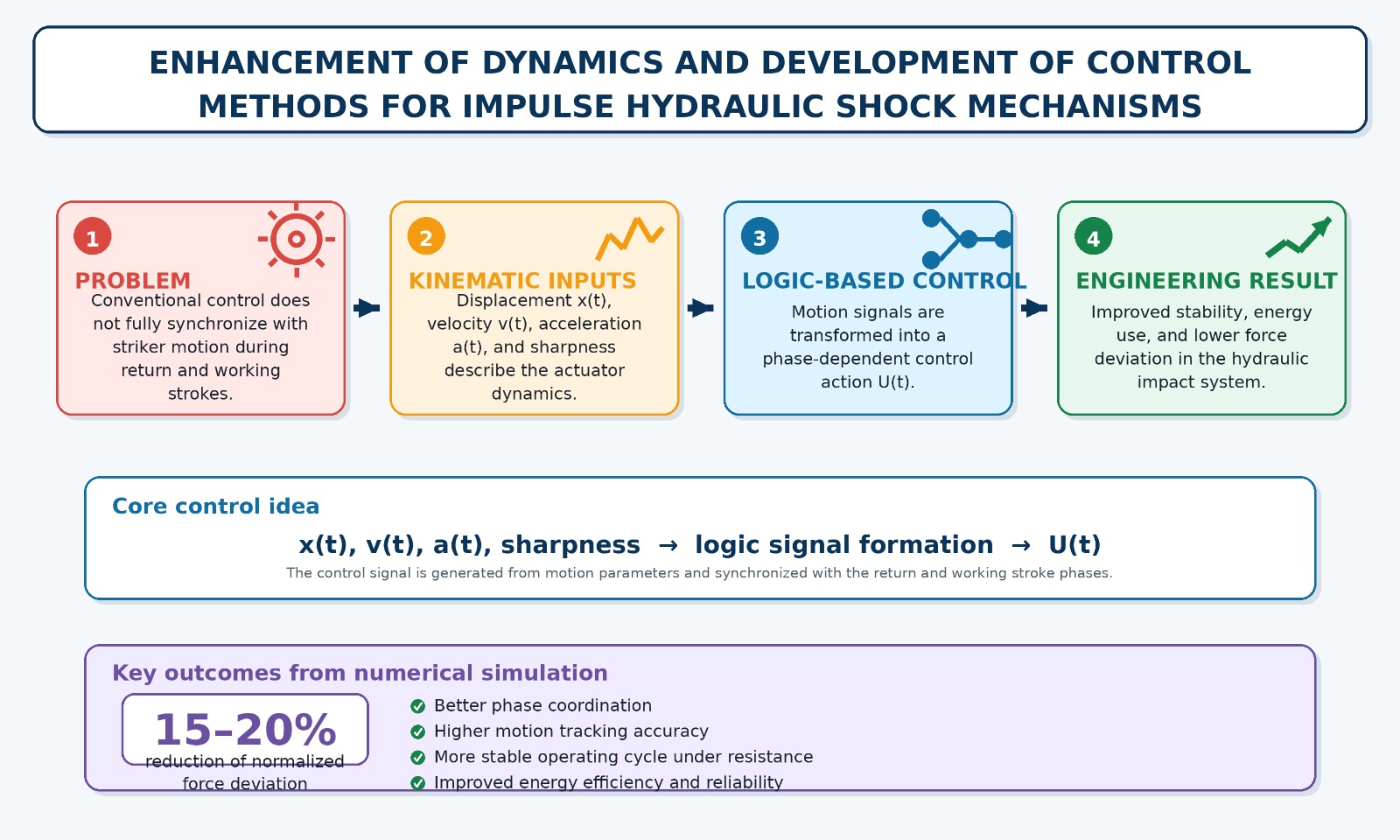
This study examines the dynamic characteristics and improvement of control methods for impulse hydraulic shock mechanisms used in high-performance hydraulic systems. The work focuses on eliminating the common discrepancy between theoretical and actual output parameters caused by inefficient processing of control signals. A mathematical model has been developed that describes the displacement, velocity, and acceleration of the actuator, taking into account nonlinear fluid dynamics and changes in external load. Based on this model, improved control methods are proposed, aimed at increasing system stability, reducing response errors, and improving the energy efficiency of the impact action. Numerical simulation has shown that adaptive input signal shaping significantly improves the system’s performance. Under identical modeling conditions, the proposed logic-based control method reduced the normalized force deviation by approximately 15–20% compared with the conventional control scheme. A logical structure for generating the input signal X(t) has been developed, ensuring more precise synchronization of dynamic processes. The results obtained contribute to the development of control methods for hydraulic shock mechanisms and propose improved algorithms applicable in engineering systems where high accuracy and reliability are required. Future plans include experimental verification of the proposed solutions on physical prototypes, as well as refinement of the mathematical models to account for the compressibility of the working fluid and real-time load changes.
References
1 Smirnov, Y.M., Uraimov, M., & Smakova, N.S. (2019). Mathematical model of hydraulic manipulators of impulse machines. Trudy Universiteta, (1), 18–22 Available at: http://tu.kstu.kz/archive/issue/11
2 Glotov, B.N., Kokenova, A.T., & Smagina, V.S. (2015). Classification of hydraulic hand hammers. Applied Research Journal, (5), 385–388. Available at: https://s.applied-research.ru/pdf/2015/2015_05_3.pdf
3 Saruev, L.A., Ziyakaev, G.R., & Pashkov, E.N. (2011). Mathematical modeling of the hydro-impulse mechanism of drilling machines. Mining Informational and Analytical Bulletin. Available at: https://cyberleninka.ru/article/n/matematicheskoe-modelirovanie-gidroimpulsnogo-mehanizma-burilnyh-mashin
4 Gorodilov, L.V. (2013). Analysis of the dynamics of two-way hydropercussion systems. Part II: Influence of design factors and their interaction with rocks. Journal of Mining Science, 49(3), 465–474. https://doi.org/10.1134/S1062739149030143 DOI: https://doi.org/10.1134/S1062739149030143
5 Smakova, N.S., Smirnov, Y.M., Kenjin, B.M., & Zhurunova, M.A. (2020). Optimal control of operating modes of hydraulic impact actuators of mining machines. Mining Informational and Analytical Bulletin (MIAB), (6), 95–104. https://doi.org/10.25018/0236-1493-2020-6-0-95-104 DOI: https://doi.org/10.25018/0236-1493-2020-6-0-95-104
6 Smakova, N., Pankov, S., Baisadykov, B., Zelenkov, V., Toibazarov, D., & Karypov, A.A. (2026). Dynamic modeling and surface integrity optimization of low-frequency hydraulic impulse systems. Eurasian Physical Technical Journal, 23(1(55)), 113–120. https://doi.org/10.31489/2026N1/113-120 DOI: https://doi.org/10.31489/2025N2/113-120
7 Zhang, Y., Zhou, D., Li, Z. (2023). Adaptive control of nonlinear hydraulic actuators using neural networks. ISA Transactions, 129, 362–375.https://doi.org/10.1016/j.isatra.2022.08.045
8 Wang, X., Li, Q., Chen, L. (2023). Optimization of hydraulic impulse systems based on machine learning algorithms. Mechanical Systems and Signal Processing, 198. https://doi.org/10.1016/j.ymssp.2023.110520 DOI: https://doi.org/10.1016/j.ymssp.2023.110520
9 Zhang, H., Liu, Y., Sun, C. (2023). Simulation and experimental study of hydraulic impulse energy conversion. Journal of Mechanical Science and Technology, 37, 2, 891–903. https://doi.org/10.1007/s12206-023-0142-2
10 Zhao, W., Chen, J., Hu, Y. (2023). Hybrid modeling and prediction of hydraulic cylinder performance using digital twin framework. Applied Sciences, 13, 4. https://doi.org/10.3390/app13042586 DOI: https://doi.org/10.3390/app13084905
11 Li, H., Yu, X., Ren, J. (2023). Research on energy-saving control of hydraulic systems based on digital twin technology. Sensors, 23, 1. https://doi.org/10.3390/s23010345 DOI: https://doi.org/10.3390/s23010345
12 Liu, P., Xie, X., Zhang, C. (2022). Machine learning-based optimization for hydraulic pump efficiency. Energies, 15, 19. https://doi.org/10.3390/en15197221 DOI: https://doi.org/10.3390/en15197221
13 Xu, H., Tian, L., Sun, W. (2023). Modeling and optimization of hydraulic impulse systems using MATLAB/Simulink. Intern. J. of Dynamics and Control, 11, 1152–1164. https://doi.org/10.1007/s40435-023-01231-8
14 Chen, R., Gao, D., Wu, Z. (2023). Deep learning for fault prediction in hydraulic systems. IEEE Access, 11, 65903–65915. https://doi.org/10.1109/ACCESS.2023.3298765
15 Sherov, K. T., Sikhimbayev, M. R., Donenbayev, B. S. (2017). Experimental research of rotational-and-frictional boring of big holes in large parts. Journal of Theoretical and Applied Mechanics, 47, 2, 67–74. https://doi.org/10.1515/jtam-2017-0018 DOI: https://doi.org/10.1515/jtam-2017-0018
16 Smakova, N. S., Sherov, K. T., Tusupova, S. O., Buzauova, T. M. (2020). The research of micro-hardness of side surfaces of teeth cylindrical wheels processed by “Shaver-Rolling Device”. Journal of Theoretical and Applied Mechanics, 50, 1, 50–56.https://doi.org/10.1515/jtam-2020-0006 DOI: https://doi.org/10.7546/JTAM.50.20.01.05
17 Zhantlesov, E. Zh., Gruzin, V. V., Togusov, A. K., Zhusupbekov, T. Kh., Zhantlesov, Zh. K. (2024) Scientific and technical substantiation of the parameters of the radiolocation device for the detection of prohibited items. Eurasian Physical Technical Journal, 21, 3 (49), 93–98.https://doi.org/10.31489/2024No3/93-98 DOI: https://doi.org/10.31489/2024No3/93-98
Downloads
Published online
How to Cite
Issue
Section
License
Copyright (c) 2026 Eurasian Physical Technical Journal

This work is licensed under a Creative Commons Attribution-NonCommercial-NoDerivatives 4.0 International License.