INVESTIGATION OF THE PARAMETERS OF A HYBRID WIND–SOLAR POWER PLANT FOR ENERGY SUPPLY OF REMOTE AUTONOMOUS CONSUMERS
Authors
-
Aliya Alkina
 Candidate of Technical Sciences, Senior Lecturer, Department of Energy Systems, Karaganda Technical University named after Abylkas Saginov, Karaganda, Kazakhstan
-
Anar S. Kuatova
Doctoral student, Department of Power Supply, S. Seifullin Kazakh Agrotechnical Research University, Astana, Kazakhstan
-
Ali D. Mekhtiyev
Candidate of Technical Sciences, Professor, Member of the Board, Vice-Rector for Research, Karaganda Technical University named after Abylkas Saginov, Karaganda, Kazakhstan
-
Aleksey V. Yurchenko
Doctor of Technical Sciences, Professor, Tomsk Polytechnic University, Tomsk, Russia
-
Bakhtybek A. Bainiyazov
Candidate of Technical Sciences, Head of the Educational Programs Group in Electric Power Engineering, S. Seifullin Kazakh Agrotechnical Research University, Astana, Kazakhstan
DOI:
https://doi.org/10.31489/2026N3/74-85Keywords:
solar energy, hybrid power system, photovoltaic panels, autonomous power supply, seasonal generation, renewable energy, seasonal complementarity, direct-current distributionAbstract
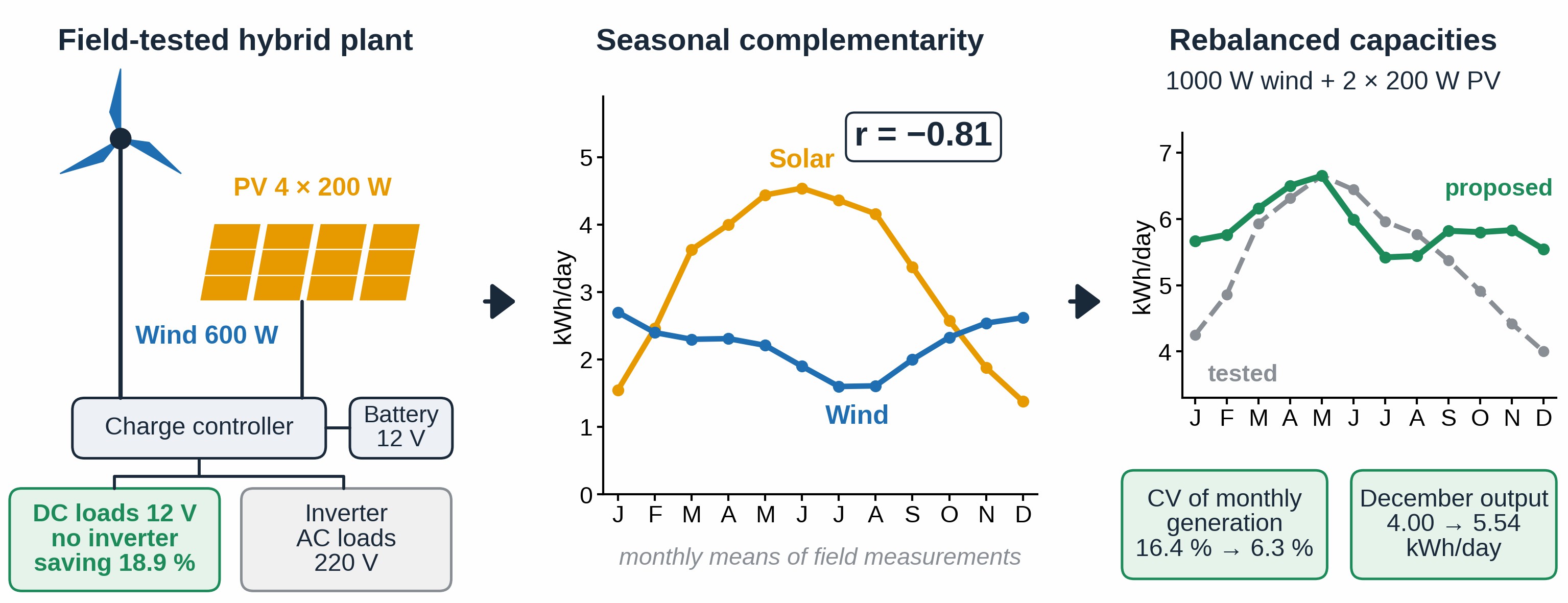
This study investigates the operating parameters of a hybrid wind–solar power plant for autonomous electricity supply in the sharply continental climate of central Kazakhstan. The plant consisted of a 600 W wind turbine, four 200 W photovoltaic panels, a 12 V battery and a charge controller, the load being separated between alternating-current and direct-current circuits. Field measurements were carried out continuously during 2025 near Karaganda. The measured generation varied seasonally from 4.0 to 6.7 kWh/day, giving an annual output of 1993 kWh, the winter minimum falling to the level of the winter load. The monthly photovoltaic and wind outputs proved strongly anti-correlated, the Pearson coefficient being −0.81, which quantifies the seasonal complementarity of the two resources. A sizing criterion based on the coefficient of variation of the monthly generation and on a seasonal reserve factor is proposed. Raising the wind capacity to 1000 W while reducing the array to two 200 W panels lowers the coefficient of variation from 16.4 to 6.3 % and raises the December output from 4.0 to 5.5 kWh/day. Direct supply of the direct-current loads without inversion saves 25.8 % of the energy delivered to them and 18.9 % at plant level.
References
Karatayev, M., Hall, S., Kalyuzhnova, Y., & Clarke, M.L. (2016). Renewable energy technology uptake in Kazakhstan: Policy drivers and barriers in a transitional economy. Renewable and Sustainable Energy Reviews, 66, 120–136. https://doi.org/10.1016/j.rser.2016.07.057 DOI: https://doi.org/10.1016/j.rser.2016.07.057
KAZENERGY. (2019). The National Energy Report 2019. Astana, Kazakhstan. Available at: https://www.kazenergy.com/upload/document/energy-report/NationalReport19_en.pdf
Xenarios, S., Darke, W., & Bekturganov, N. (2024). Clean energy challenges and innovation opportunities in Kazakhstan. Environmental Research Communications, 6(8), 085005. https://doi.org/10.1088/2515-7620/ad87b5 DOI: https://doi.org/10.1088/2515-7620/ad87b5
Karatayev, M., & Clarke, M. L. (2016). A review of current energy systems and green energy potential in Kazakhstan. Renewable and Sustainable Energy Reviews, 55, 491–504. https://doi.org/10.1016/j.rser.2015.10.078 DOI: https://doi.org/10.1016/j.rser.2015.10.078
Zhakiyev, N., Burkhanova, D., Nurkanat, A., Zhussipkaliyeva, S., Sospanova, A., & Khamzina, A. (2025). Green energy in grey areas: The financial and policy challenges of Kazakhstan's energy transition. Energy Research & Social Science, 124, 104046. https://doi.org/10.1016/j.erss.2025.104046 DOI: https://doi.org/10.1016/j.erss.2025.104046
Temirgaliyeva, N., & Junussova, M. (2020). Renewable Electricity Production and Sustainability of the National and Regional Power Systems of Kazakhstan. International Journal of Energy Economics and Policy, 10(3), 58–67. https://doi.org/10.32479/ijeep.9150 DOI: https://doi.org/10.32479/ijeep.9150
Koshim, A., Karaca, F., & Clarke, M. L. (2015). Current Energy Resources in Kazakhstan and the Future Potential of Renewables: A Review. Energy Procedia, 59, 97–104. https://doi.org/10.1016/j.egypro.2014.10.354 DOI: https://doi.org/10.1016/j.egypro.2014.10.354
Akbulut, A., Seker, O., Ozcan, S., & Beycioğlu, G. (2025). Energy, exergy and enviro-economic analysis of a hybrid energy plant utilizing biogas and solar technologies in the Almaty region, Republic of Kazakhstan. Energy Strategy Reviews, 11, 101118. https://doi.org/10.1016/j.cscee.2025.101118 DOI: https://doi.org/10.1016/j.cscee.2025.101118
Darke, W., Xenarios, S., & Zhakiyev, N. (2025). From fossil fuels to renewables: Analysing efficacy and impact of auctions to attract investment in resource-rich Kazakhstan. Energy Strategy Reviews, 53, 101470. https://doi.org/10.1016/j.esr.2025.101470 DOI: https://doi.org/10.1016/j.sftr.2025.101308
Zereshkian, S., & Mansoury, D. (2023). Solar-wind hybrid energy system to supply electricity for offshore oil and gas platforms in the Caspian Sea: A case study. The Journal of Engineering, 2023(6), e12239. https://doi.org/10.1049/tje2.12239 DOI: https://doi.org/10.1049/tje2.12239
Xu, J., Assenova, A., & Erokhin, V. (2018). Renewable Energy and Sustainable Development in a Resource-Abundant Country: Challenges of Wind Power Generation in Kazakhstan. Sustainability, 10(9), 3315. https://doi.org/10.3390/su10093315 DOI: https://doi.org/10.3390/su10093315
Karatayev, M., & Hall, S. (2020). Establishing and comparing energy security trends in resource-rich exporting nations (Russia and the Caspian Sea region). Resources Policy, 68, 101746. https://doi.org/10.1016/j.resourpol.2020.101746 DOI: https://doi.org/10.1016/j.resourpol.2020.101746
Aliev, A. K., Dyusenov, K. M., Sednin, A. V., & Baimukhamedov, M. F. (2024). Development of a Hybrid Wind-Solar Energy Complex. Proceedings of the University, 1(94), 436–443. https://doi.org/10.52209/1609-1825_2024_1_436 [in Russian] DOI: https://doi.org/10.52209/1609-1825_2024_1_436
Lavrik, A. Yu., Zhukovsky, Yu. L., Lavrik, A., & Buldysko, A. D. (2020). Features of the optimal composition of a wind-solar power plant with diesel generators. Power Engineering: Research, Equipment, Technology, 22(1), 10–17. https://doi.org/10.30724/1998-9903-2020-22-1-10-17 [in Russian] DOI: https://doi.org/10.30724/1998-9903-2020-22-1-10-17
Dzendzerskii, V. A., Zhitnik, N. E., Plaksin, S. V., Pogorelaya, L. M., & Burak, I. I. (2007). Principles of Designing Hybrid Wind-Solar Power Systems. Elektrotekhnika ta elektroenergetika, (1), 67-72. [in Russian]
Roy, P., He, J., Zhao, T., & Singh, Y. V. (2022). Recent Advances of Wind-Solar Hybrid Renewable Energy Systems for Power Generation: A Review. IEEE Open Journal of the Industrial Electronics Society, 3, 81–104. https://doi.org/10.1109/OJIES.2022.3144093 DOI: https://doi.org/10.1109/OJIES.2022.3144093
Boute, A. (2020). Regulatory stability and renewable energy investment: The case of Kazakhstan. Renewable and Sustainable Energy Reviews, 121, 1009673. https://doi.org/10.1016/j.rser.2019.109673 DOI: https://doi.org/10.1016/j.rser.2019.109673
Kumar, R. (2025). Renewable Energy Future: Can Large-Scale Solar and Wind Energy Projects in Kazakhstan and Uzbekistan Reduce Dependence on Fossil Fuels and Alter the Region’s Energy Geography? International Journal of Research Studies on Environment, Earth, and Allied Sciences, 2(4), 14–17. https://doi.org/10.5281/zenodo.17590177
Han, S., Zhang, L., Liu, Y., Zhang, H., Yan, J., Li, L., Lei, X., & Wang, X. (2019). Quantitative evaluation method for the complementarity of wind–solar–hydro power and optimization of wind–solar ratio. Applied Energy, 236, 973–984. https://doi.org/10.1016/j.apenergy.2018.12.059 DOI: https://doi.org/10.1016/j.apenergy.2018.12.059
Khan, H. A., & Siraj, K. (2020). DC distribution for residential power networks – A framework to analyze the impact of voltage levels on energy efficiency. Energy Reports, 6, 944–951. https://doi.org/10.1016/j.egyr.2020.04.018 DOI: https://doi.org/10.1016/j.egyr.2020.04.018
Haroon, A., Gelani, H. E., Tahir, H., & Manzoor, H. U. (2025). DC vs. AC distribution: Revealing the efficiency advantage of DC in today's energy landscape. PLOS ONE, 20(5), e0318444. https://doi.org/10.1371/journal.pone.0318444 DOI: https://doi.org/10.1371/journal.pone.0318444
Machidon, D., & Istrate, M. (2023). Tilt angle adjustment for incident solar energy increase: A case study for Europe. Sustainability, 15(8), 7015. https://doi.org/10.3390/su15087015 DOI: https://doi.org/10.3390/su15087015
Dufo-López, R., Cortés-Arcos, T., Artal-Sevil, J. S., & Bernal-Agustín, J. L. (2021). Comparison of lead-acid and Li-ion batteries lifetime prediction models in stand-alone photovoltaic systems. Applied Sciences, 11(3), 1099. https://doi.org/10.3390/app11031099 DOI: https://doi.org/10.3390/app11031099
Pryor, S. C., Shepherd, T. J., & Barthelmie, R. J. (2018). Interannual variability of wind climates and wind turbine annual energy production. Wind Energy Science, 3(2), 651–665. https://doi.org/10.5194/wes-3-651-2018 DOI: https://doi.org/10.5194/wes-3-651-2018
Downloads
Published online
How to Cite
Issue
Section
License
Copyright (c) 2026 Eurasian Physical Technical Journal

This work is licensed under a Creative Commons Attribution-NonCommercial-NoDerivatives 4.0 International License.