COSMOLOGICAL EVOLUTION DYNAMICS AND OM(Z) DIAGNOSTIC IN A SCALAR–FERMION MODEL WITH A GENERALIZED SCALE FACTOR
Authors
-
Aisara Ratbay
 PhD student, Department of General and Theoretical Physics, L.N. Gumilyov Eurasian National University, Astana, Kazakhstan
-
Olga Razina
PhD, Professor, Department of General and Theoretical Physics, L.N. Gumilyov Eurasian National University, Astana, Kazakhstan
-
Pyotr Tsyba
PhD, Associate Professor, Department of General and Theoretical Physics, L.N. Gumilyov Eurasian National University, Astana, Kazakhstan
-
Enilik Satbekova
Master’s student, Department of General and Theoretical Physics, L.N. Gumilyov Eurasian National University, Astana, Kazakhstan
DOI:
https://doi.org/10.31489/2026N3/144-153Keywords:
Scalar–fermion interaction, Yukawa coupling, cosmic acceleration, dark energy models, Om(z) parameterAbstract
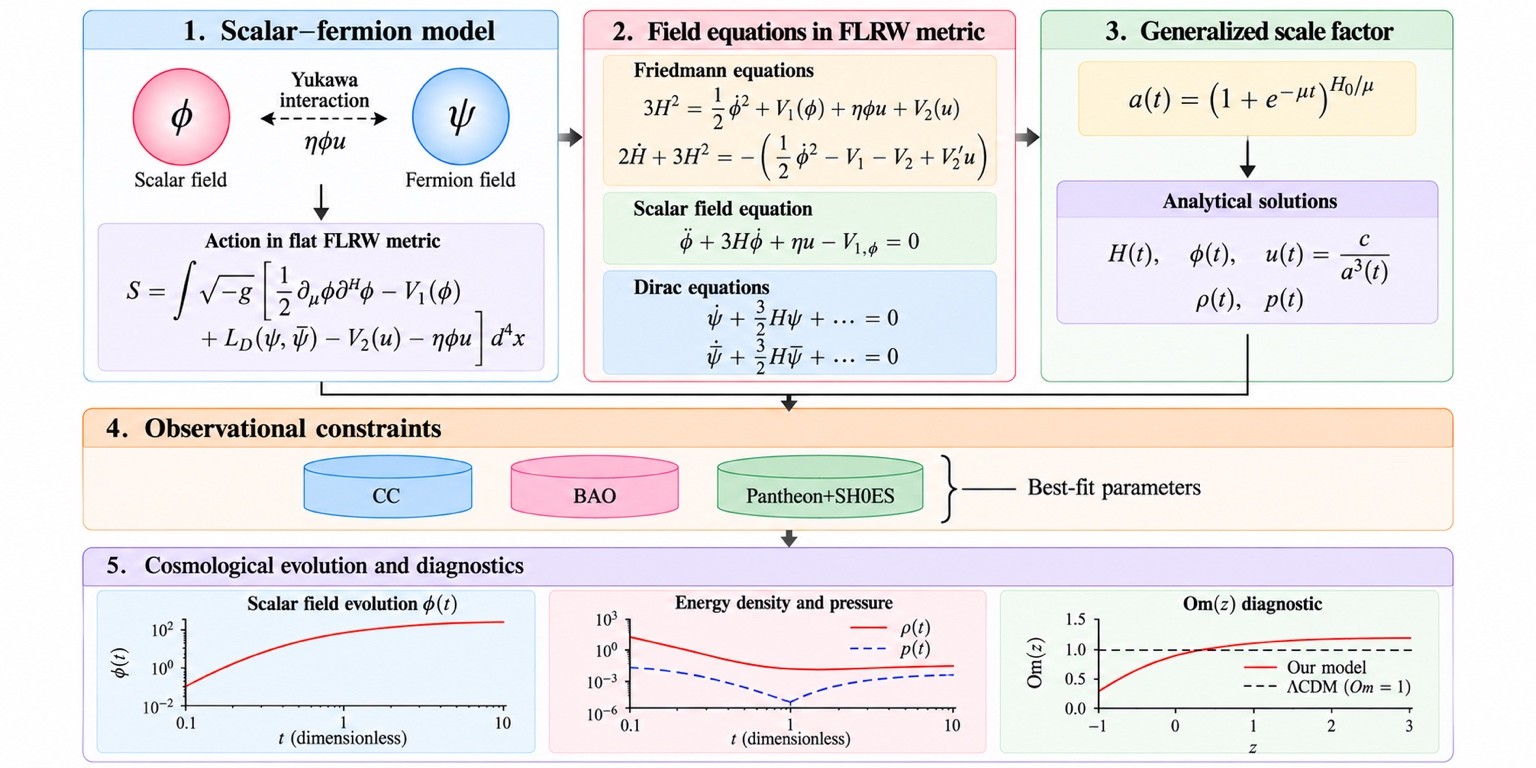
A cosmological model of an expanding Universe with scalar–fermion interactions is considered.Our model is based on the interaction of scalar and fermion fields via a Yukawa-type coupling, which influences the development of cosmological expansion in its late stages. The generalized scale factor is used to study the evolution and dynamics of the system. This approach allows us to explore various expansion regimes and analyze the contribution of fields, namely, the scalar and fermion components, to the total energy density and pressure. The viability of the cosmological evolution model is studied using the dimensionless Hubble parameter and the Om(z) diagnostic.The behavior obtained differs from the standard case, where the parameter remains constant. Our results show that the effective component of dark energy dynamically evolves as the Universe expands. Our analysis demonstrates that the interaction of scalar and fermion fields can significantly influence the history and evolution of the expansion and lead to stable cosmological behavior. The proposed model can be used for further studies of dark energy interaction scenarios.
References
Planck Collaboration. (2020). Planck 2018 results. VI. Cosmological parameters. Astronomy & Astrophysics, 641, A6. https://doi.org/10.1051/0004-6361/201833910 DOI: https://doi.org/10.1051/0004-6361/201833910
Riess, A.G., Filippenko, A.V., Challis, P., Clocchiatti, A., Diercks, A., Garnavich, P.M., Gilliland R.L., Hogan C.J., Jha S., Kirshner R.P., Leibundgut B., Phillips M.M., Reiss D., Schmidt B.P., Schommer R., Smith R.C., Spyromilio J., Stubbs C., Suntzeff N.B., Tonry J. (1998). Observational evidence from supernovae for an accelerating universe and a cosmological constant. Astronomical Journal, 116, 1009–1038. https://doi.org/10.1086/300499 DOI: https://doi.org/10.1086/300499
Perlmutter, S., Aldering, G., Goldhaber, G., Knop, R.A., Nugent, P., Castro, P.G., Deustua, S., Fabbro, S., Goobar, A., Groom, D.E., Hook, I.M., Kim, A.G., Kim, M.Y., Lee, J.C., Nunes, N.J., Pain, R., Pennypacker, C.R., Quimby, R., Lidman, C., Ellis, R.S., Irwin, M., McMahon, R.G., Ruiz-Lapuente, P., Walton, N., Schaefer, B., Boyle, B.J., Filippenko, A.V., Matheson, T., Fruchter, A.S., Panagia, N., Couch, W.J., Sutherland, R. (1999). Measurements of Ω and Λ from 42 high-redshift supernovae. Astrophysical Journal, 517, 565–586. https://doi.org/10.1086/307221 DOI: https://doi.org/10.1086/307221
Copeland, E.J., Sami, M., Tsujikawa, S. (2006). Dynamics of dark energy. International Journal of Modern Physics D, 15, 1753–1936. https://doi.org/10.1142/S021827180600942X DOI: https://doi.org/10.1142/S021827180600942X
Ratra, B., Peebles, P.J.E. (1988). Cosmological consequences of a scalar field. Physical Review D, 37, 3406–3427. https://doi.org/10.1103/PhysRevD.37.3406 DOI: https://doi.org/10.1103/PhysRevD.37.3406
Caldwell, R.R., Dave, R., Steinhardt, P.J. (1998). Cosmological imprint of dark energy. Physical Review Letters, 80, 1582–1585. https://doi.org/10.1103/PhysRevLett.80.1582 DOI: https://doi.org/10.1103/PhysRevLett.80.1582
7Saha, B. (2001). Spinor field cosmology. Physical Review D, 64, 123501. DOI:10.1103/PhysRevD.64.123501 DOI: https://doi.org/10.1103/PhysRevD.64.123501
Ribas, M.O., Devecchi, F.P., Kremer, G.M. (2005). Fermions as sources of accelerated regimes in cosmology. Physical Review D, 72, 123502. https://doi.org/10.1103/PhysRevD.72.123502 DOI: https://doi.org/10.1103/PhysRevD.72.123502
Razina, O.V., Tsyba, P.Yu., Altayeva, G., Myrzakulova, S. (2023). Power law solution of a cosmological model with non-minimal coupled the fermionic field. AIP Conference Proceedings, 2872(1), 060004. https://doi.org/10.1063/5.0162898 DOI: https://doi.org/10.1063/5.0162898
Tsyba, P.Yu., Razina, O.V., Suikimbayeva, N.T. (2021). Analysis of cosmological tachyon and fermion model and observation data constraints. International Journal of Modern Physics D, 30(15), 2150114. https://doi.org/10.1142/S0218271821501145 DOI: https://doi.org/10.1142/S0218271821501145
Razina, O.V., Tsyba, P.Yu., Suikimbayeva, N.T. (2021). Tachyonization Cosmological Model in the Framework of Linear Form-Invariance Transformations. Eurasian Physical Technical Journal, 18(3), 93–100. https://doi.org/10.31489/2021No3/93-100 DOI: https://doi.org/10.31489/2021No3/93-100
Chakrabarti, S., Lahiri, A. (2022). Scalar–fermion interaction as the driver of cosmic acceleration. Physics of the Dark Universe, 37, 1–15. https://doi.org/10.1016/j.dark.2022.101121 DOI: https://doi.org/10.1016/j.dark.2022.101121
Razina, O.V., Myrzakulov, Y.M., Serikbayev, N.S., Nugmanova, G., Myrzakulov, R. (2011). G-essence cosmologies with scalar-fermion interactions. European Physical Journal Plus, 126(9), 85. https://doi.org/10.1140/epjp/i2011-11085-9 DOI: https://doi.org/10.1140/epjp/i2011-11085-9
Sahni, V., Shafieloo, A., Starobinsky, A.A. (2008). Two new diagnostics of dark energy. Physical Review D, 78, 103502. https://doi.org/10.1103/PhysRevD.78.103502 DOI: https://doi.org/10.1103/PhysRevD.78.103502
Alcaniz, J.S. (2004). Some observational consequences of dark energy cosmologies. Physical Review D, 69, 083521. https://doi.org/10.1103/PhysRevD.69.083521 DOI: https://doi.org/10.1103/PhysRevD.69.083521
Moresco, M., Pozzetti, L., Cimatti, A., Jimenez, R., Maraston, C., Verde, L., Pozzetti, L., Tojeiro, R., Bolzonella, M., Zucca, E., et al. (2016). A 6% measurement of the Hubble parameter at z≈0.45: direct evidence of the epoch of cosmic re-acceleration. Journal of Cosmology and Astroparticle Physics, 2016(05), 014. https://doi.org/10.1088/14757516/2016/05/014 DOI: https://doi.org/10.1088/1475-7516/2016/05/014
DESI Collaboration. (2024). DESI 2024 results: Cosmological constraints from baryon acoustic oscillations. https://arxiv.org/abs/2404.03002
Brout, D., Scolnic, D., Popovic, B., Riess, A.G., Riess, A.G., Jones, D.O., et al. (2022). The Pantheon+ Analysis: Cosmological Constraints. Astrophysical Journal, 938(2), 110. https://doi.org/10.3847/1538-4357/ac8e04 DOI: https://doi.org/10.3847/1538-4357/ac8e04
Downloads
Published online
How to Cite
Issue
Section
License
Copyright (c) 2026 Eurasian Physical Technical Journal

This work is licensed under a Creative Commons Attribution-NonCommercial-NoDerivatives 4.0 International License.