COULD GLOBULAR CLUSTERS IN THE VICINITY OF THE GALACTIC CENTRE HAVE CONTRIBUTED STARS TO THE NUCLEAR STAR CLUSTER IN THE PAST?
Authors
-
Mukhagali Kalambay
 PhD, researcher, Fesenkov Astrophysical Institute, Almaty, Kazakhstan; Associate professor, Heriot-Watt International Faculty, K. Zhubanov Aktobe Regional University, Aktobe, Kazakhstan. Scopus Author ID: 59365823900
-
Dana Kuvatova
PhD student, Al-Farabi Kazakh National University, Fesenkov Astrophysical Institute, Almaty, Kazakhstan
-
Maryna Ishchenko
Dr., Leading Researcher, Main Astronomical Observatory, National Academy of Sciences of Ukraine, Kyiv, Ukraine; Fesenkov Astrophysical Institute, Almaty, Kazakhstan
-
Peter Berczik
Dr (Sci)., Leading Researcher, Fesenkov Astrophysical Institute, Almaty, Kazakhstan; Main Astronomical Observatory, NAS of Ukraine, Kyiv, Ukraine
-
Chingis Omarov
Dr., Professor, Fesenkov Astrophysical Institute, Almaty, Kazakhstan
-
Anatoly Kusakin
Dr., Leading Researcher, Fesenkov Astrophysical Institute, Almaty, Kazakhstan
DOI:
https://doi.org/10.31489/2026N3/154-163Keywords:
Globular Cluster, Nuclear Star cluster, Dynamical evolution, Milky Way, Time-variable galactic potential, N-body modelling, star accretionAbstract
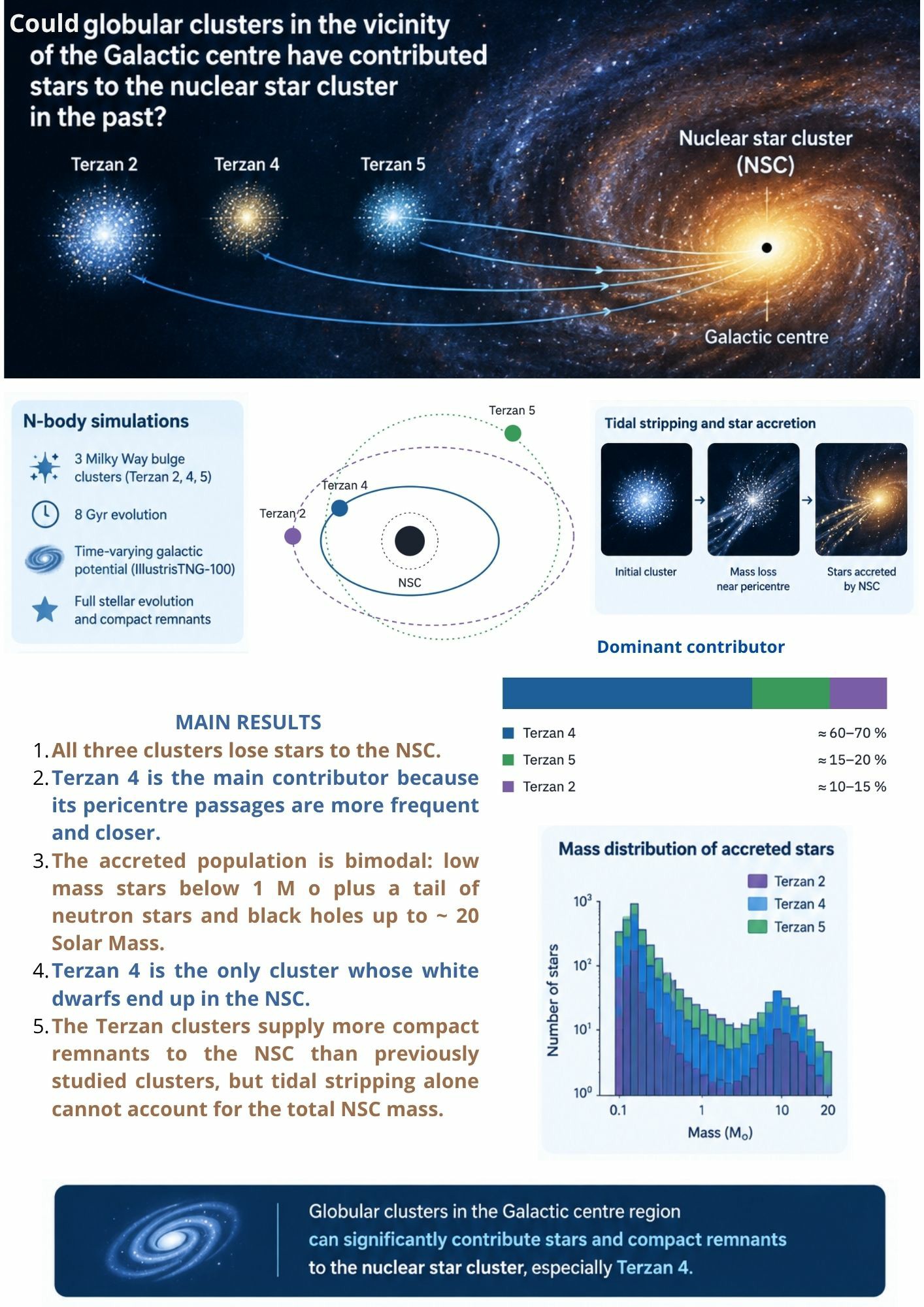
The results of direct N-body simulations of three Milky Way bulge globular clusters – Terzan 2, Terzan 4, and Terzan 5 – evolving in a time-varying galactic potential derived from the IllustrisTNG-100 cosmological database over 8 Gyr are presented. Incorporating full stellar evolution and compact remnant formation, we quantify the probability and efficiency of stellar accretion onto the Galactic nuclear star cluster (NSC) during close pericentre passages of these three clusters. To parametrize the effect of dynamical friction in the dense central environment, we introduce a velocity reduction factor (Vred) ranging from 1.00 to 0.10. It was found that all three clusters contribute stars to the NSC even in the absence of velocity reduction, with a combined bound stellar count of ~730 stars and a total accreted mass of ~278 M☉ at Vred = 1.00, growing to ~5420 stars and ~1175 M☉ at Vred = 0.10. Terzan 4 is the dominant contributor across all velocity reduction factors, reflecting its more frequent and closer pericentre passages near the Galactic centre. The mass distribution of accreted stars reveals a bimodal structure: a low-mass component below ~1 M☉ whose capture is independent of Vred, and a prominent high-mass tail extending to ~20 M☉ corresponding to neutron stars and black holes, which grows with decreasing Vred. Notably, Terzan 4 is the only cluster for which white dwarfs are also captured by the NSC at every Vred value. Our results suggest that the Terzan family represents a more significant source of compact remnants for the Galactic NSC than previously studied clusters, while confirming that tidal stripping of surviving globular clusters alone cannot account for the total NSC mass.
References
Neumayer, N., Seth, A., & Böker, T. (2020). Nuclear star clusters. The Astronomy and Astrophysics Review, 28(1), 4. https://doi.org/10.1007/s00159-020-00125-0 DOI: https://doi.org/10.1007/s00159-020-00125-0
Feldmeier-Krause, A., Zhu, L., Neumayer, N., van de Ven, G., de Zeeuw, P. T., & Schödel, R. (2017). Triaxial orbit-based modelling of the Milky Way nuclear star cluster. Monthly Notices of the Royal Astronomical Society, 466(4), 4040-4052. https://doi.org/10.1093/mnras/stw3377 DOI: https://doi.org/10.1093/mnras/stw3377
Pfuhl, O., Fritz, T. K., Zilka, M., Maness, H., Eisenhauer, F., Genzel, R., Ott, T., Dodds-Eden, K., & Sternberg, A. (2011). The star formation history of the Milky Way's Nuclear Star Cluster. The Astrophysical Journal, 741(2), 108. https://doi.org/10.1088/0004-637X/741/2/108 DOI: https://doi.org/10.1088/0004-637X/741/2/108
Tremaine, S. D., Ostriker, J. P., & Spitzer, L. (1975). The formation of the nuclei of galaxies. I. M31. The Astrophysical Journal, 196, 407-411. https://ui.adsabs.harvard.edu/abs/1975ApJ...196..407T DOI: https://doi.org/10.1086/153422
Fahrion, K., Leaman, R., Lyubenova, M., & van de Ven, G. (2022). Disentangling the formation mechanisms of nuclear star clusters. Astronomy & Astrophysics, 658, A172. https://doi.org/10.1051/0004-6361/202039778 DOI: https://doi.org/10.1051/0004-6361/202039778
Ishchenko, M., Berczik, P., Panamarev, T., Kuvatova, D., Kalambay, M., Gluchshenko, A., Veles, O., Sobolenko, M., Sobodar, O., & Omarov, C. (2024). Dynamical evolution of Milky Way globular clusters on the cosmological timescale-I. Mass loss and interaction with the nuclear star cluster. Astronomy & Astrophysics, 689, A178. https://doi.org/10.1051/0004-6361/202450399 DOI: https://doi.org/10.1051/0004-6361/202450399
Antonini, F., Capuzzo-Dolcetta, R., Mastrobuono-Battisti, A., & Merritt, D. (2012). Dissipationless formation and evolution of the Milky Way nuclear star cluster. The Astrophysical Journal, 750(2), 111. https://doi.org/10.1088/0004-637X/750/2/111 DOI: https://doi.org/10.1088/0004-637X/750/2/111
Aharon, D., & Perets, H. B. (2015). Formation and evolution of nuclear star clusters with in situ star formation: nuclear cores and age segregation. The Astrophysical Journal, 799(2), 185. https://doi.org/10.1088/0004-637X/799/2/185 DOI: https://doi.org/10.1088/0004-637X/799/2/185
Gao, Y., Li, H., Zhang, X., Su, M., & Ng, S. C. Y. (2024). Globular clusters contribute to the nuclear star clusters and galaxy centre γ-ray excess, moderated by galaxy assembly history. Monthly Notices of the Royal Astronomical Society, 527(3), 7731-7742. https://ui.adsabs.harvard.edu/abs/2024MNRAS.527.7731G DOI: https://doi.org/10.1093/mnras/stad3585
Gnedin, O. Y., Lee, H. M., & Ostriker, J. P. (1999). Effects of tidal shocks on the evolution of globular clusters. The Astrophysical Journal, 522(2), 935-949. https://ui.adsabs.harvard.edu/abs/1999ApJ...522..935G DOI: https://doi.org/10.1086/307659
Ishchenko, M., Sobolenko, M., Kuvatova, D., Panamarev, T., & Berczik, P. (2023). Milky Way globular clusters on cosmological timescales-II. Interaction with the Galactic center. Astronomy & Astrophysics, 674, A70. https://doi.org/10.1051/0004-6361/202245753 DOI: https://doi.org/10.1051/0004-6361/202245753
Pillepich, A., Nelson, D., Hernquist, L., Springel, V., Pakmor, R., Torrey, P., Weinberger, R., Genel, S., Naiman, J. P., Marinacci, F., & Vogelsberger, M. (2018). First results from the IllustrisTNG simulations: the stellar mass content of groups and clusters of galaxies. Monthly Notices of the Royal Astronomical Society, 475(1), 648-675. https://doi.org/10.1093/mnras/stx3112 DOI: https://doi.org/10.1093/mnras/stx3112
Nelson, D., Springel, V., Pillepich, A., Rodriguez-Gomez, V., Torrey, P., Genel, S., Vogelsberger, M., Pakmor, R., Marinacci, F., Weinberger, R., Kelley, L., Lovell, M., Diemer, B., & Hernquist, L. (2019). The IllustrisTNG simulations: public data release. Computational Astrophysics and Cosmology, 6(1), 2. https://doi.org/10.1186/s40668-019-0028-x DOI: https://doi.org/10.1186/s40668-019-0028-x
Ishchenko, M., Sobolenko, M., Berczik, P., Omarov, C., Sobodar, O., Kalambay, M., & Yurin, D. (2023). Milky Way globular clusters on cosmological timescales-III. Interaction rates. Astronomy & Astrophysics, 678, A69. https://doi.org/10.1051/0004-6361/202346553 DOI: https://doi.org/10.1051/0004-6361/202346553
Ferraro, F. R., Dalessandro, E., Mucciarelli, A., Beccari, G., Rich, R. M., Origlia, L., Lanzoni, B., Rood, R. T., Valenti, E., Bellazzini, M., Ransom, S. M., & Cocozza, G. (2009). The cluster Terzan 5 as a remnant of a primordial building block of the Galactic bulge. Nature, 462(7272), 483-486. https://ui.adsabs.harvard.edu/abs/2009Natur.462..483F DOI: https://doi.org/10.1038/nature08581
Origlia, L., Rich, R. M., Ferraro, F. R., Lanzoni, B., Bellazzini, M., Dalessandro, E., Fabbri, S., & Beccari, G. (2011). Spectroscopy unveils the complex nature of Terzan 5. The Astrophysical Journal Letters, 726(2), L20. https://doi.org/10.1088/2041-8205/726/2/L20 DOI: https://doi.org/10.1088/2041-8205/726/2/L20
Kroupa, P. (2001). On the variation of the initial mass function. Monthly Notices of the Royal Astronomical Society, 322(2), 231-246. https://doi.org/10.1046/j.1365-8711.2001.04022.x DOI: https://doi.org/10.1046/j.1365-8711.2001.04022.x
Hurley, J. R., Pols, O. R., & Tout, C. A. (2000). Comprehensive analytic formulae for stellar evolution as a function of mass and metallicity. Monthly Notices of the Royal Astronomical Society, 315(3), 543-569. https://doi.org/10.1046/j.1365-8711.2000.03426.x DOI: https://doi.org/10.1046/j.1365-8711.2000.03426.x
King, I. R. (1966). The structure of star clusters. III. Some simple dynamical models. The Astronomical Journal, 71, 64. https://ui.adsabs.harvard.edu/abs/1966AJ.....71...64K DOI: https://doi.org/10.1086/109857
Ishchenko, M., Berczik, P., & Kuvatova, D. (2026). Dynamical evolution of Milky Way globular clusters on the cosmological timescale II. Terzan 2, 4, and 5 mass loss and collision tracking. Astronomy & Astrophysics, 710, A58. https://doi.org/10.1051/0004-6361/202659137 DOI: https://doi.org/10.1051/0004-6361/202659137
Panamarev, T., Just, A., Spurzem, R., Berczik, P., Wang, L., & Arca Sedda, M. (2019). Direct N-body simulation of the Galactic centre. Monthly Notices of the Royal Astronomical Society, 484(3), 3279-3290. https://doi.org/10.1093/mnras/stz208 DOI: https://doi.org/10.1093/mnras/stz208
Berczik, P., Nitadori, K., Zhong, S., Spurzem, R., Hamada, T., Wang, X., Berentzen, I., Veles, A., & Ge, W. (2011, October). High performance massively parallel direct N-body simulations on large GPU clusters. In International conference on High Performance Computing (pp. 8-18). https://ui.adsabs.harvard.edu/abs/2011hpc..conf....8B
Banerjee, S., Belczynski, K., Fryer, C. L., Berczik, P., Hurley, J. R., Spurzem, R., & Wang, L. (2020). BSE versus StarTrack: implementations of new wind, remnant-formation, and natal-kick schemes in NBODY7 and their astrophysical consequences. Astronomy & Astrophysics, 639, A41. https://doi.org/10.1051/0004-6361/201935332 DOI: https://doi.org/10.1051/0004-6361/201935332
Kalambay, M., Ishchenko, M., Kuvatova, D., Panamarev, T., & Berczik, P. (2026). The contribution to Galactic Centre γ-ray excess from cluster-born millisecond pulsars: constraints from direct N-body simulations. Astronomy & Astrophysics, 708, A89. https://doi.org/10.1051/0004-6361/202557963 DOI: https://doi.org/10.1051/0004-6361/202557963
Kuvatova, D., Ishchenko, M., Berczik, P., Veles, O., Sobodar, O., & Panamarev, T. (2026). How our proto-nuclear star cluster formed and grew due to early globular cluster disruption – I. Case of low masses. Astronomy & Astrophysics, 706, A220. https://doi.org/10.1051/0004-6361/202556182 DOI: https://doi.org/10.1051/0004-6361/202556182
Downloads
Published online
How to Cite
Issue
Section
License
Copyright (c) 2026 Eurasian Physical Technical Journal

This work is licensed under a Creative Commons Attribution-NonCommercial-NoDerivatives 4.0 International License.