Modernization of a thermal desorption spectroscopy setup for high-sensitivity analysis of hydrogen and helium isotopes
Authors
-
Timur Kulsartov
 Candidate of Physical and Mathematical Sciences, Senior Researcher, Institute of Experimental and Theoretical Physics, al-Farabi Kazakh National University, Almaty, Kazakhstan
-
Assyl Akhanov
Institute of Nuclear Physics ARKAE, Almaty, Kazakhstan
-
Saulet Askerbekov
PhD, Associate Professor, Institute of Experimental and Theoretical Physics, al-Farabi Kazakh National University, Almaty, Kazakhstan, Institute of Nuclear Physics ARKAE, Almaty, Kazakhstan
-
Asset Shaimerdenov
PhD, Associate Professor, Institute of Nuclear Physics ARKAE, Almaty, Kazakhstan
-
Yevgen Chikhray
Candidate of Technical Sciences, Senior Researcher, Institute of Experimental and Theoretical Physics, al-Farabi Kazakh National University, Almaty, Kazakhstan
-
Zhanar Bugybay
PhD student, Institute of Nuclear Physics ARKAE, Almaty, Kazakhstan
DOI:
https://doi.org/10.31489/2026N3/94-102Keywords:
thermal desorption spectroscopy (TDS), mass spectrometry, tritium-breeding materials, gas evolution mechanismsAbstract
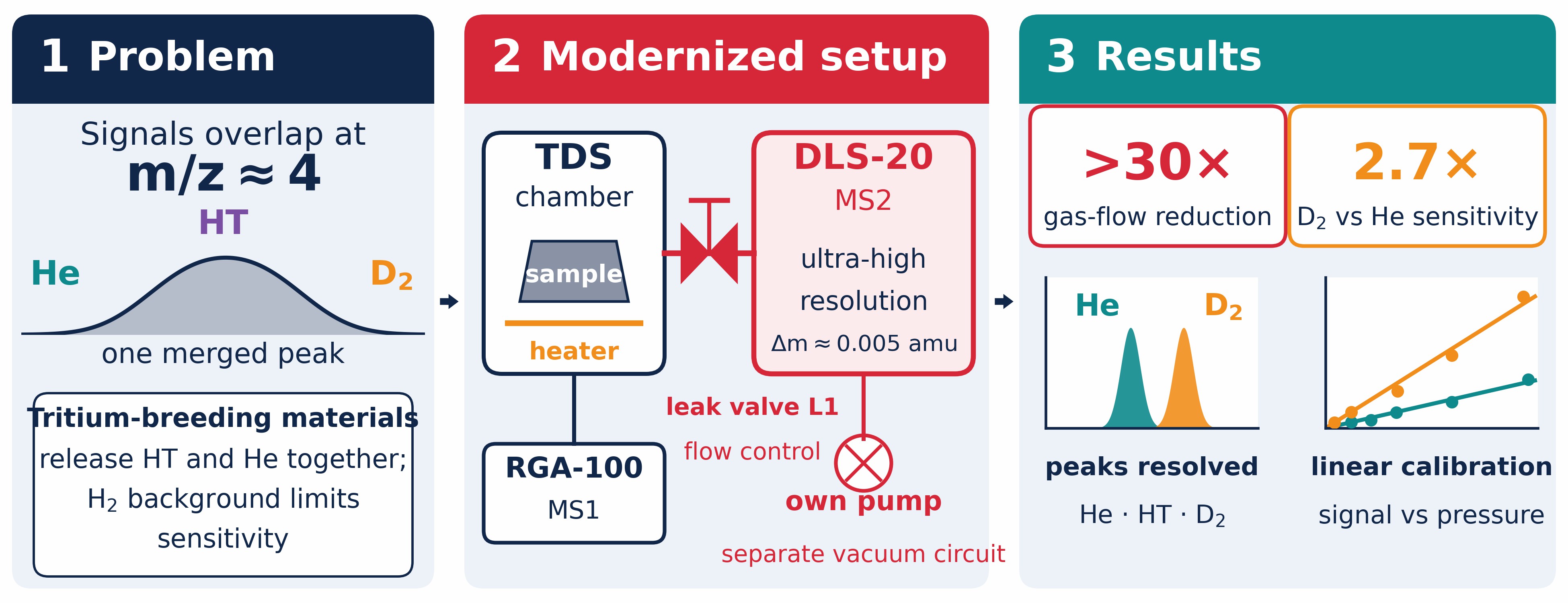
This paper presents the results of an engineering and technical development aimed at modernizing a thermal desorption spectroscopy (TDS) system to enhance the sensitivity of gas-phase mass spectrometry analysis. The measurement system was integrated with a high-sensitivity DLS-20 mass spectrometer operating in conjunction with an RGA-100 quadrupole residual gas analyzer. A vacuum circuit separation scheme utilizing an adjustable leak valve was implemented, providing precise gas flow control and ensuring the stable operation of the DLS-20 analyzer in the low-pressure regime. The relevance of this work stems from the investigation of processes and the determination of gas release mechanisms from tritium-breeding materials, where hydrogen isotopes (primarily as HT molecules) and helium are generated simultaneously. During mass spectrometry analysis, their signals overlap at the mass-to-charge ratio of m/z≈4, which complicates the interpretation of TDS experimental data. It is demonstrated that adjusting the opening degree of the mechanical leak valve allows for a more than 30-fold reduction in the gas flow entering the analyzer. The system was calibrated using helium-deuterium mixtures, revealing that the detection sensitivity for deuterium is approximately 2.7 times higher than that for helium. Reliable resolution of the helium, HT, and D2 peaks was achieved. The obtained results demonstrate the feasibility of utilizing the modernized setup for high-sensitivity investigations of tritium, hydrogen isotope, and helium release processes, as well as for improving the reliability of TDS spectra interpretation.
References
Tal-Gutelmacher, E., Eliezer, D., & Abramov, E. (2007). Thermal desorption spectroscopy (TDS)–Application in quantitative study of hydrogen evolution and trapping in crystalline and non-crystalline materials. Materials Science and Engineering: A, 445–446, 625–631. https://doi.org/10.1016/j.msea.2006.09.089 DOI: https://doi.org/10.1016/j.msea.2006.09.089
Askerbekov, S., Aitkulov, M., Shaimerdenov, A., Kulsartov, T., Akhanov, A., Bugybay, Z., & Sairanbayev, D. (2025). Gas release kinetics from neutron irradiated Li2TiO3 samples. Fusion Eng. Des., 216, Article 115060. https://doi.org/10.1016/j.fusengdes.2025.115060 DOI: https://doi.org/10.1016/j.fusengdes.2025.115060
Ma, H.-Z., Li, Y.-H., Niu, Y.-Z., Hua, Y.-C., Kong, X.-S., Cheng, L., Zhou, H.-B., Lu, G., Gao, F., & Lu, G.-H. (2025). Thermal desorption of hydrogen in damaged materials and its implication for defect characterization. Acta Materialia, 294, 121130. https://doi.org/10.1016/j.actamat.2025.121130 DOI: https://doi.org/10.1016/j.actamat.2025.121130
Kulsartov, T. V., Zaurbekova, Zh. A., & Chikhray, E. V. (2018). Development of a technique for TDS experiments with induction heating of hydrogen-pre-saturated samples. Vestn. NNC (J. NNC), (4), 129–133. https://doi.org/10.52676/1729-7885-2018-4-129-133 [in Russian] DOI: https://doi.org/10.52676/1729-7885-2018-4-129-133
Chikhray, Y., Askerbekov, S., Knitter, R., Kulsartov, T., Shaimerdenov, A., Aitkulov, M., Akhanov, A., Sairanbayev, D., Bugybay, Z., Nessipbay, A., Kisselyov, K., Kizane, G., & Zarins, A. (2024). Studies of irradiated two-phase lithium ceramics Li4SiO4/Li2TiO3 by thermal desorption spectroscopy. Nucl. Mater. Energy, 38, Article 101621. https://doi.org/10.1016/j.nme.2024.101621 DOI: https://doi.org/10.1016/j.nme.2024.101621
Kozlovskiy, A.L., Abyshev, B., Zhumadilov, K.Sh., & Shlimas, D.I. (2022). Influence of phase formation processes in lithium zirconate ceramics on strength and thermal properties. Eurasian Physical Technical Journal, 19, 2(40), 13–18. https://doi.org/10.31489/2022No2/13-18 DOI: https://doi.org/10.31489/2022No2/13-18
Causey, R. A. (2012). Studies of hydrogen retention and release in fusion materials, IAEA, 17–26. http://www-pub.iaea.org/MTCD/Publications/PDF/apid15_web.pdf.
Federici, G., Skinner, C. H., Brooks, J. N., Coad, J. P., Grisolia, C., Haasz, A. A., Hassanein, A., Philipps, V., Pitcher, C., Roth, J., Wampler, W. R., & Whyte, D. G. (2002). Plasma-material interactions in current tokamaks and their implications for next step fusion reactors. Nuclear Fusion, 41(12), 1967. https://doi.org/10.1088/0029-5515/41/12/218 DOI: https://doi.org/10.1088/0029-5515/41/12/218
Roth, J., Tsitrone, E., Loarte, A., Loarer, T., Counsell, G., Neu, R., Philipps, V., Brezinsek, S., Lehnen, M., Coad, P., Grisolia, C., Schmid, K., Krieger, K., Kallenbach, A., Lipschultz, B., Doerner, R., Causey, R., Alimov, V., Shu, W., & Kukushkin, A. (2009). Recent analysis of key plasma wall interactions issues for ITER. Journal of Nuclear Materials, 390–391, 1–9. https://doi.org/10.1016/j.jnucmat.2009.01.037 DOI: https://doi.org/10.1016/j.jnucmat.2009.01.037
Hiden Analytical. (2020). Mass spectrometers for residual gas analysis (RGA) [Brochure]. https://www.hiden.fr/wp-content/uploads/2020/11/TDS-188-7-RGA-Catalogue_High-Res.pdf
Hiden Analytical. (2026). DLS-20: Quadrupole Mass Spectrometer. https://www.hidenanalytical.com/products/residual-gas-analysis/dls-20/
Downloads
Published online
How to Cite
Issue
Section
License
Copyright (c) 2026 Eurasian Physical Technical Journal

This work is licensed under a Creative Commons Attribution-NonCommercial-NoDerivatives 4.0 International License.