












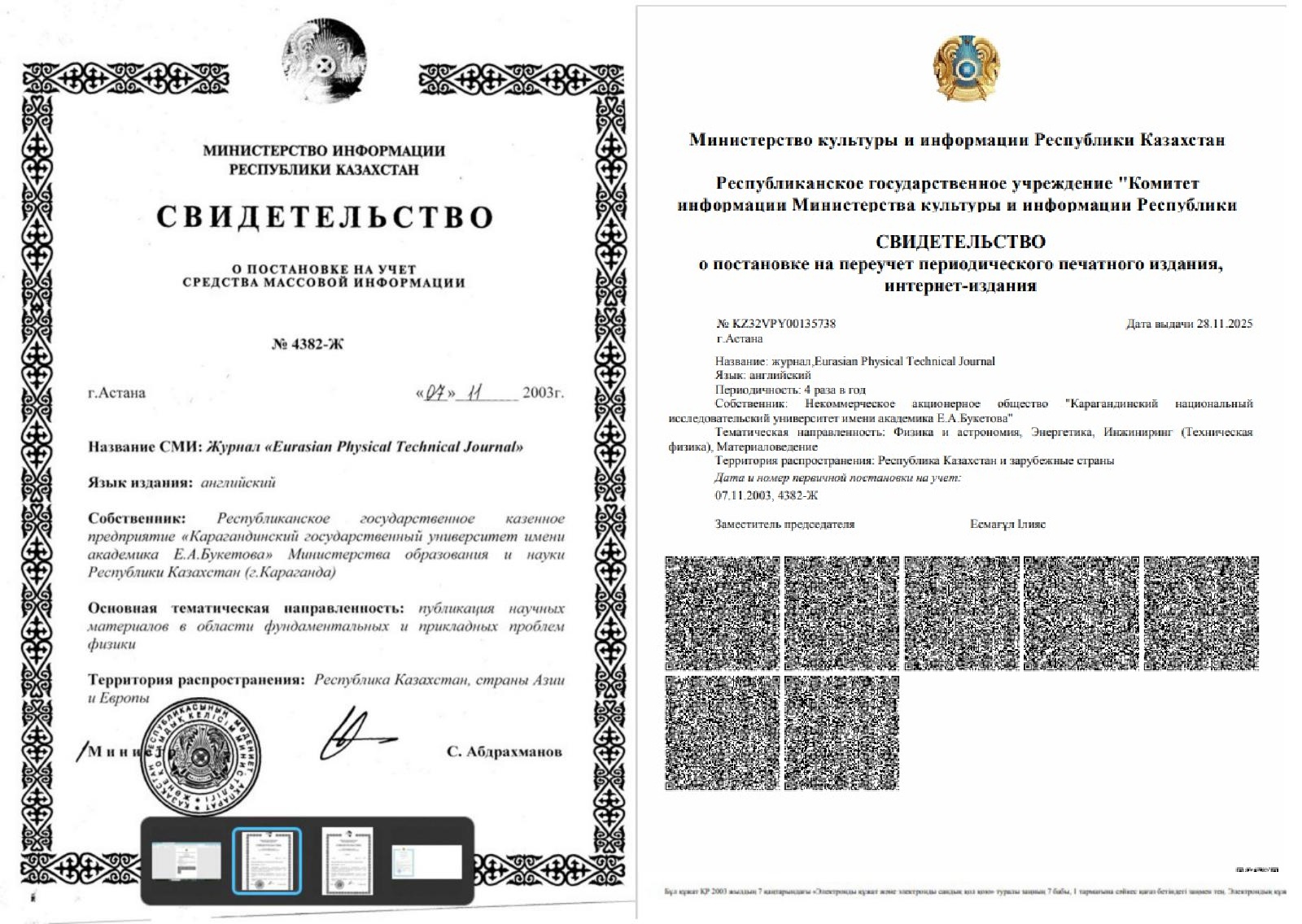
Certificates of registration and re-registration
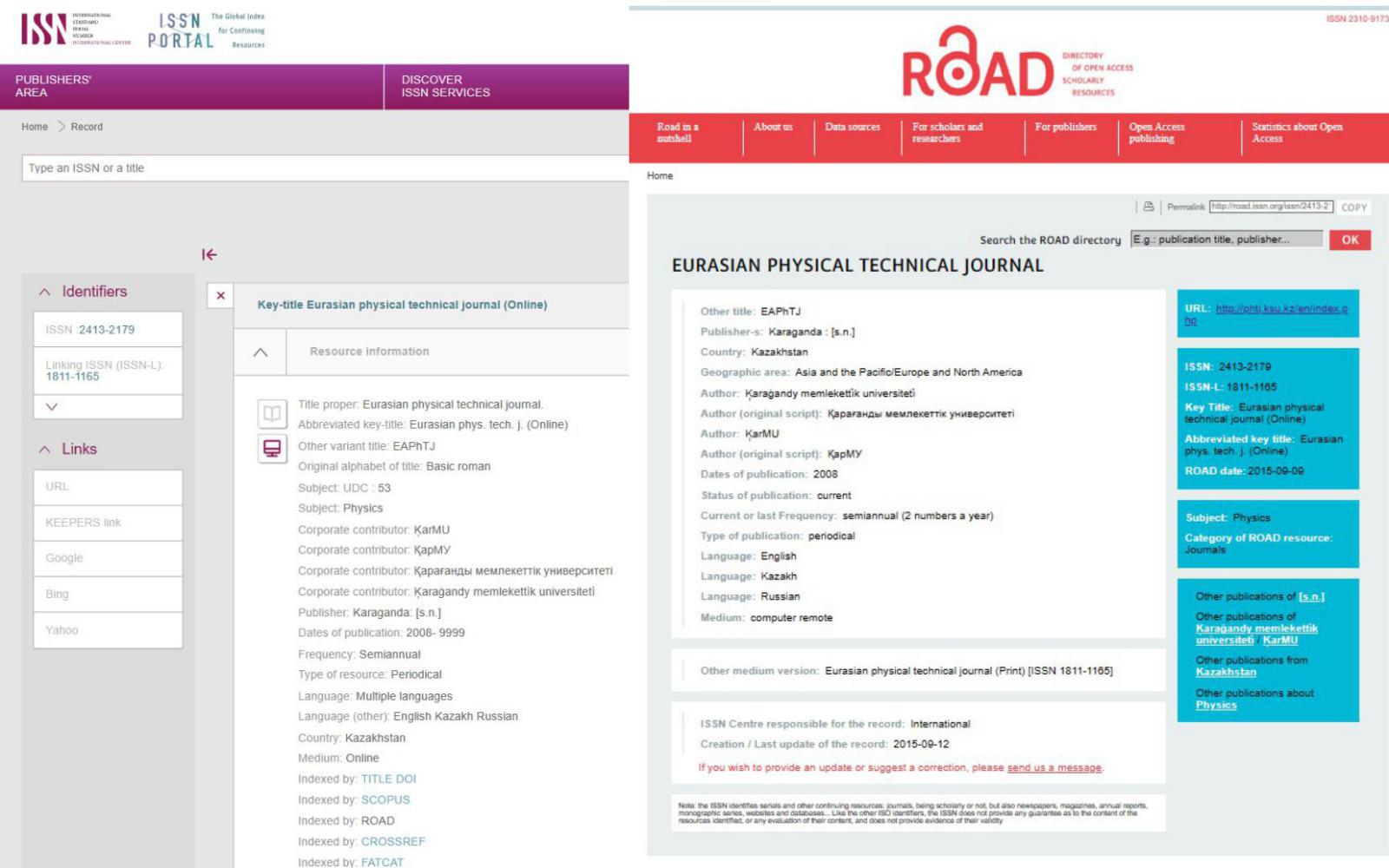
Confirmation of ISSN and Open Access status
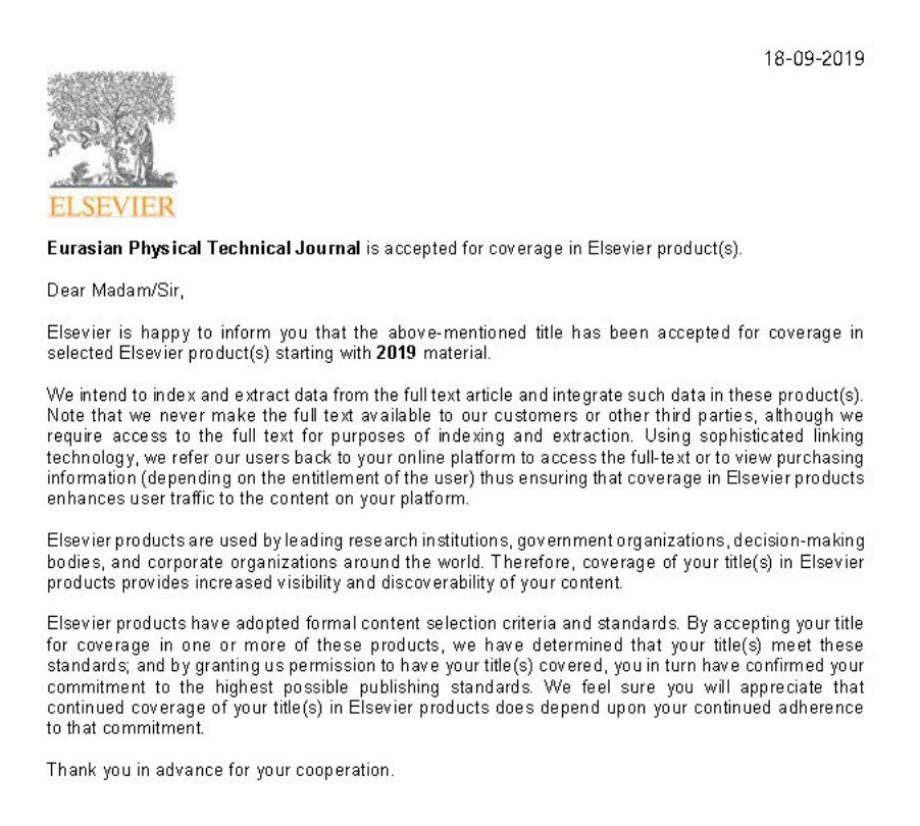
Confirmation of indexing in the SCOPUS database
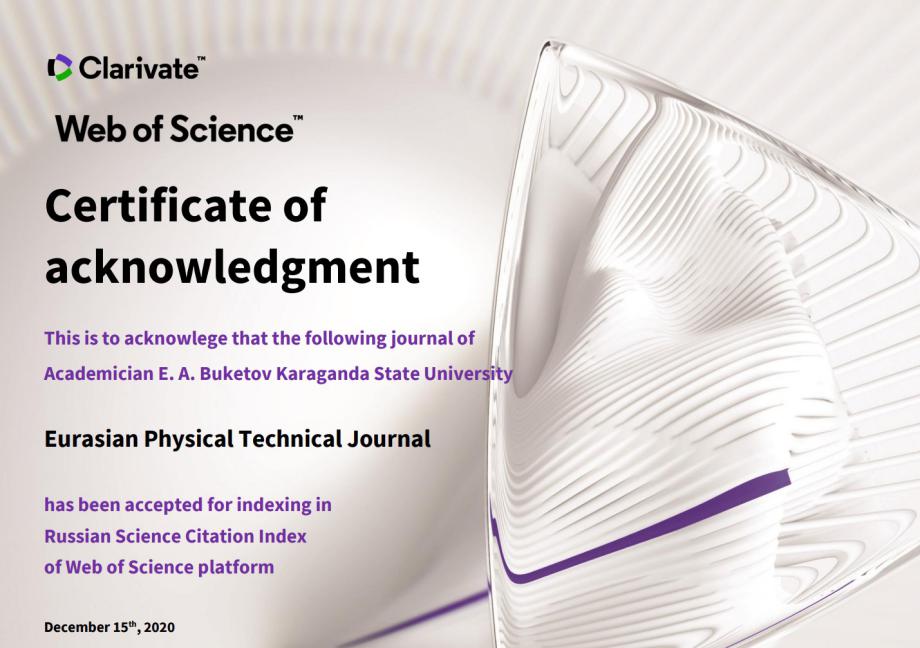
WoS Certificate of RCSI Indexing
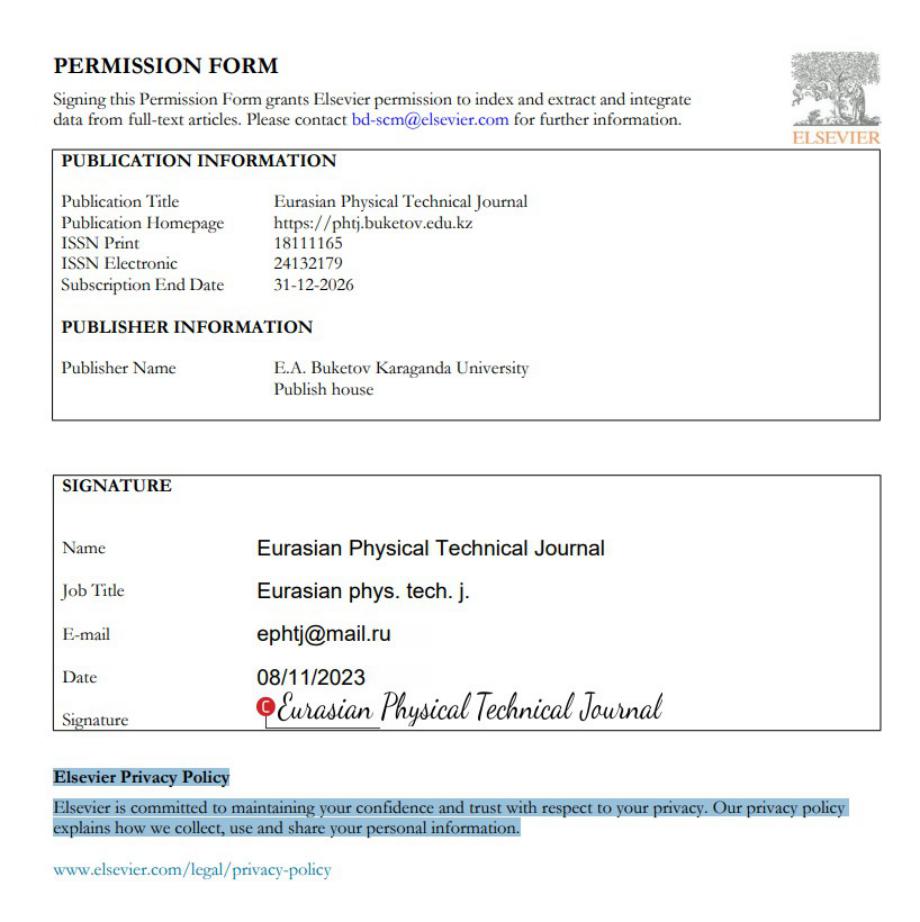
Elsevier permission
Publication in the Eurasian Physical Technical Journal is a direct reflection of the quality of the authors' research work and the reputation of the institution that supports them. Original research articles, as well as review articles with analytical descriptions of current problems in physical and technical sciences, are accepted for publication.
Authors are encouraged to submit research papers that have scientific novelty and practical value after careful reading and review. Make sure that the article material is structured and meets all of the requirements listed below. Submissions will be rejected and returned to the authors if they do not meet these requirements.
A scientific article should contain the results of original scientific research previously unpublished and not intended for publication in other publications. Manuscript of the article should contain at least 75% of the original text.
In "Eurasian phys. tech. j." articles are published in English in 4 scientific areas of technical physics: Energy; Engineering; Materials Science; Physics and Astronomy. The corresponding author must indicate the Journal section in which the article will be published.
A scientific article, including a bibliography, should not exceed 10-12 pages of text, including tables, formulas, figures (no more than 10) and a list of references (no more than 20-25), typed on a computer in Microsoft Word.
A review article should not exceed 25 pages, including no more than 20 figures and references no more than 35.
All abbreviations, with the exception of standard and generally accepted ones, should be deciphered the first time they are used in the text.
|
1. |
Article Title |
|
2. |
Abstract |
|
3. |
Keywords |
|
4. |
Introduction |
|
5. |
Methods |
|
6. |
Results and discussion |
|
7. |
Conclusions |
|
8. |
Conflict of interest statement |
|
9. |
CRediT Author statement* |
|
10. |
Statement on the use of Artificial Intelligence* |
|
11. |
Acknowledgements / Funding* |
|
12. |
Appendix. Supplementary materials* |
|
13. |
Data Availability Statement* |
|
14. |
References |
|
15. |
Authors’ information |
* Sections 9–13 should be included where applicable.
The structure of the article includes the following sections:
Article title, which includes:
• UDC (Universal Decimal Classification) index is written on a separate line, on the left. Since the ISSN of the journal is registered for the publication of scientific articles in physics, first select and write a suitable index from subsections 53 Physics, then add other, see https://udcsummary.info/php/index.php?tag=5&lang=en
• The title of the article should be placed below.
• Information about the authors (surname and initials)
• Affiliations of authors (place of main work, institution, city, country)
• E-mail address of the corresponding author, responsible for submitting the manuscript for publication
Abstract should consist of at least 5-6 sentences, not exceeding 200 words without formula, references, abbreviations. An abstract briefly outlines the relevance and purpose of the study, the object and methods of the study, the main results and conclusions.
Authors should provide 3 to 10 keywords or brief phrases that accurately represent the subject of the manuscript. Formulas and abbreviations should not be used in the keywords.
The text of the article should be divided into structural parts as IMRaD+C: Introduction (Defines the research problem, states the purpose or hypothesis, and provides context for the study);
Methods (Describes how research was conducted, including research design, object, measure or/and modeling technique, setting, participants);
Results and discussion (Results, Analysis, Discussion) +
Conclusion (Summarizes the main findings, states the contribution to the field, and suggests future research).
The article text must be formatted according to the Template (font - Times New Roman, size - 11 pt; line spacing - single; alignment - in width), link to the Template
Mathematical equations should be prepared carefully to ensure clarity, consistency, and proper formatting throughout the manuscript. Please follow these requirements:
• All mathematical equations must be submitted as editable text and not as images.
• Equations must be created using the MathType or the built-in Equation Editor in Microsoft Word.
• Variables should be presented in italic type.
• Denote powers of e by exp.
• Displayed equations should be placed on a separate line from the main text.
• Equations must be numbered consecutively in the order of appearance throughout the manuscript.
• Equation numbers should be aligned to the right margin.
• References to equations in the text should appear in the format: (1), (2), (3) – (5).
• Mathematical equations are considered part of the sentence; therefore, appropriate punctuation must follow each equation: use a comma if the sentence continues after the equation; use a period if the sentence ends after the equation.
Tables should be prepared clearly and consistently according to the following requirements:
• Tables must be submitted as editable text and not as images.
• Tables should be inserted next to the relevant text.
• All tables must be cited in the manuscript text.
• Tables should be numbered consecutively in the order of their appearance in the text.
• Each table must include a title/caption placed above the table.
• Any notes or explanations should be placed below the table body.
• Avoid the use of vertical lines and cell shading within tables.
• Table text should be formatted in Times New Roman, 10 pt.
• The table header must not contain empty cells.
• All tables must be presented in portrait orientation.
• Tables should be used sparingly and must not duplicate data already have described in the text.
Figures, images, artwork, diagrams, and other graphical materials must be submitted as separate files together with the manuscript. Each figure should be uploaded as a separate file using а logical naming convention (for example, Figure_1, Figure_2, etc). Compressed ZIP archives may be used when submitting multiple figure files.
Please follow these requirements:
All figures must be of high quality with a minimum resolution of 300 dpi. Text, symbols, and graphical elements must be clear, sharp, and fully legible. Blurred lines, pixelation, background noise, or visual distortions are not acceptable.
Accepted figure file formats include TIFF, JPEG, PNG.
Every figure must be cited in the manuscript text before its appearance using the format: Fig. 1, Fig. 2-4, Fig. 5a. The figure citation must appear in the same section or subsection where the figure is presented.
Each figure must have a caption placed below the image in the following format: Fig. 1. Title of the figure.
For multi-part figures, captions should be formatted as follows:
Fig. 1. Title of the figure: (a) description of the first subfigure; (b) description of the second subfigure.
The inscriptions in the figure should not be bold or italic.
All inscriptions in the figure must use the same font type and size. The only exception applies to software screenshots where font editing is not possible.
The authors declare that they have no conflict of interest in relation to this research, whether financial, personal, authorship or otherwise, that could affect the research and its results presented in this paper.
According to the requirements for publications indexed in the SCOPUS database, if there is more than one author, it is necessary to briefly indicate the contribution of each author to the preparation of the article, recognized authorship contribution categories (only relevant contributions should be indicated). The final manuscript must be read and approved by all authors.
CRediT roles
| Conceptualization | Ideas; formulation or evolution of overarching research goals and aims. |
| Data curation | Management activities to annotate (produce metadata), scrub data and maintain research data (including software code, where it is necessary for interpreting the data itself) for initial use and later re-use. |
| Formal analysis | Application of statistical, mathematical, computational, or other formal techniques to analyze or synthesize study data. |
| Funding acquisition | Acquisition of the financial support for the project leading to this publication. |
| Investigation | Conducting a research and investigation process, specifically performing the experiments, or data/evidence collection. |
| Methodology | Development or design of methodology; creation of models. |
| Project administration | Management and coordination responsibility for the research activity planning and execution. |
| Resources | Provision of study materials, reagents, materials, patients, laboratory samples, animals, instrumentation, computing resources, or other analysis tools. |
| Software | Programming, software development; designing computer programs; implementation of the computer code and supporting algorithms; testing of existing code components. |
| Supervision | Oversight and leadership responsibility for the research activity planning and execution, including mentorship external to the core team. |
| Validation | Verification, whether as a part of the activity or separate, of the overall replication/reproducibility of results/experiments and other research outputs. |
| Visualization | Preparation, creation and/or presentation of the published work, specifically visualization/data presentation. |
| Writing – original draft | Preparation, creation and/or presentation of the published work, specifically writing the initial draft (including substantive translation). |
| Writing – review & editing | Preparation, creation and/or presentation of the published work by those from the original research group, specifically critical review, commentary, or revision – including pre or post-publication stages. |
The authors declare that no artificial intelligence tools were used to generate scientific content, results, or conclusions of this article. Artificial intelligence tools were used exclusively for language editing and grammatical improvements, in accordance with the journal’s ethical policy on the responsible use of artificial intelligence technologies. https://phtj.buketov.edu.kz/EPTJ/generative-ai
If generative AI tools have been used, authors must provide a statement specifying the name, version, model, and source of the AI technology applied.
Acknowledgments and Funding information should be presented in a separate section before the References.
Acknowledgments: Include individuals who provided assistance during the research or manuscript preparation
Funding. Authors must disclose all sources of financial support for the research and/or preparation of the manuscript.
Example: This work was supported by ____________ (grant numbers ____________).
Authors must indicate whether the data supporting the findings of the study are available and specify the conditions of access.
Examples:
• The data are available upon reasonable request from the authors.
• The data that support the findings of this article are openly available.
• The data that has been used is confidential.
• No data were created or analyzed in this study.
Authors are responsible for ensuring the accuracy and completeness of all references. Self-citations, i.e., references to publications by all co-authors, should not exceed 25%. Authors should provide a bibliography in accordance with international publishing requirements, using standard journal abbreviations. Use APA-style bibliographic citation format.
Please follow these requirements when preparing the reference list:
Citations in Text
References should be cited in the text using square brackets in the format [1], [2], [3–5].
References must be numbered consecutively in the order of their first appearance in the manuscript.
Every reference listed in the reference section must be cited in the text, and all in-text citations must correspond to an entry in the reference list.
Reference List
The reference list should appear at the end of the manuscript in ascending numerical order.
Authors are encouraged to format references according to APA style, with numerical citations used in the text.
Standard journal abbreviations may be used where appropriate.
All references must be provided in their original publication language.
Authors must verify that all URLs and DOIs are active and accessible before submission.
Minimum Requirements
At least 50% of references must be from international/foreign publications indexed in Scopus and WoS databases.
At least 50% of references must be from sources published within the last 10 years.
The proportion of self-citations must not exceed 25% of the total reference list.
Reference Formatting
Please ensure references include complete bibliographic information according to the source type:
• Books, monographs, patents, and abstracts:
Author(s). (Year) Title. Publisher, city (if applicable), total number of pages. DOI or URL (if available).
• Journal articles, conference proceedings, and collected volumes:
Author(s). (Year). Title of article. Journal/Proceedings Title, volume(issue), page range. DOI or URL (if available).
• Online resources/websites: Author(s) (if available). Title of webpage/document. URL and access date.
Additional Recommendations
Before submitting the manuscript to the editor, it is necessary to check all URL sources for operability.
Every reference listed in the reference section must be cited in the text, and all in-text citations must correspond to an entry in the reference list.
The following files must be uploaded to the journal's website:
• Text of the article in Microsoft Word format, possibly with pictures (*.doc); The article and all documentation must be identified by the 1st author’s name: Akhmetov AA_et al_paper; Akhmetov AA_et al_fig.1; Akhmetov AA_et al_Cover letter; ect.
• Figures/illustration (fig1.jpg, fig2.jpg, …);
• Figure captions (*.doc);
• Graphical Abstract (.jpg, .png, or .tif);
• Cover letter from a university, research institute or organization licensed to conduct research activities must be issued on official letterhead and/or certified by the seal of the organization. By this letter, the university management confirms that the materials of the article (the article title and the authors names have to written in English) based the results obtained by authors do not contain any information representing state or commercial secrets, and the article can be published in the open press. Authors must upload a copy of the signed Covering Letter in PdF format to the journal website. Based on the covering letter the Conflict-of-interest statement will be written.
• Authors’ information: full name of each author, academic degree, academic title, place of work or study, organization, city, country; SCOPUS Author ID; ORCID iD; contact details (email, phone).
• Receipt of payment. Authors should pay for the publication only after receiving notification about a positive decision of the reviewers. https://phtj.buketov.edu.kz/index.php/EPTJ/payment-information
Authors are required to provide a graphical abstract at submission. A graphical abstract is a concise visual summary of the main findings of the paper. It should clearly present the core message of the research and enable readers to quickly identify papers most relevant to their research interests.
Requirements:
• Ensure that all necessary permissions have been obtained for any third-party material used in the image.
• If generative AI or AI-assisted tools were used in creating the graphical abstract, their use must comply with the journal’s policy on AI-generated content (available in the Author Guidelines).
• Submit graphical abstract as a separate file in the online submission system.
• Image size: minimum 560 × 1100 pixels (height × width). or proportionally more, and is readable at a size of 5 x 13 cm.
• Minimum resolution: 300 dpi.
• Accepted formats: PNG or JPEG.
• Use clear, legible fonts with sufficiently large size.
• Do not include the title “Graphical Abstract,” borders, or excessive white space.
• The image should be professional, visually appealing, and self-explanatory.
Submission: Upload the graphical abstract as a separate file during manuscript submission. If accepted, it will be published alongside the text abstract.
Supplementary materials are files, data, or documents that accompany a scientific article but are not included in the main text. Authors are encouraged to provide supplementary materials to enhance the scientific value of their research.
Supplementary materials contain details supporting the research (datasets, videos, methods, tables) that are useful to the reader but are not essential to understanding the main findings.
Supplementary materials are published electronically only on the journal website, not in the print version.
Supplementary materials are subject to the same copyright as the corresponding article.
Please follow these guidelines:
• Supplementary materials must be accurate, relevant, and directly related to the submitted research.
• All supplementary files must be cited in the manuscript text.
• Supplementary materials should be submitted together with the manuscript at the time of submission.
• Each file must include a brief and descriptive caption explaining its content.
• After submission, supplementary files may only be added or replaced during the revision stage of the editorial process.
• Supplementary files should be provided in commonly accessible file formats.
Certificates of registration and re-registration
Confirmation of ISSN and Open Access status
Confirmation of indexing in the SCOPUS database
WoS Certificate of RCSI Indexing
Elsevier permission