Selective degradation characteristics of SILVER-CLAD MAGNESIUM alloy biodegradable implants with for osteosynthesis applications
Authors
-
Viktor Greshta
 Candidate of Technical Sciences, Professor, Rector of Zaporizhzhya Polytechnic National University, Ukraine
-
Gulmira Sharipovna Yar-Mukhamedova
Doctor of Phys. and Math. Sciences, Professor, Al-Farabi Kazakh National University, Almaty, Kazakhstan
-
Akmaral Karimovna Imanbayeva
Candidate of Phys. and Math. Sciences, Researcher, Al-Farabi Kazakh National University; Almaty, Kazakhstan
-
Anna Dzhus
PhD student, Senior Lecturer, Department of Physical Materials Science, Zaporizhzhya Polytechnic National University, Ukraine
-
Daniel M. Zellele
PhD, Researcher, Bahir Dar University, Ethiopia; Al-Farabi Kazakh National University, Kazakhstan
DOI:
https://doi.org/10.31489/2026N3/28-36Keywords:
selective degradation, biodegradable implant, corrosion, osteosynthesis, Ringer-Locke solution, magnesium alloys, silver coatingAbstract
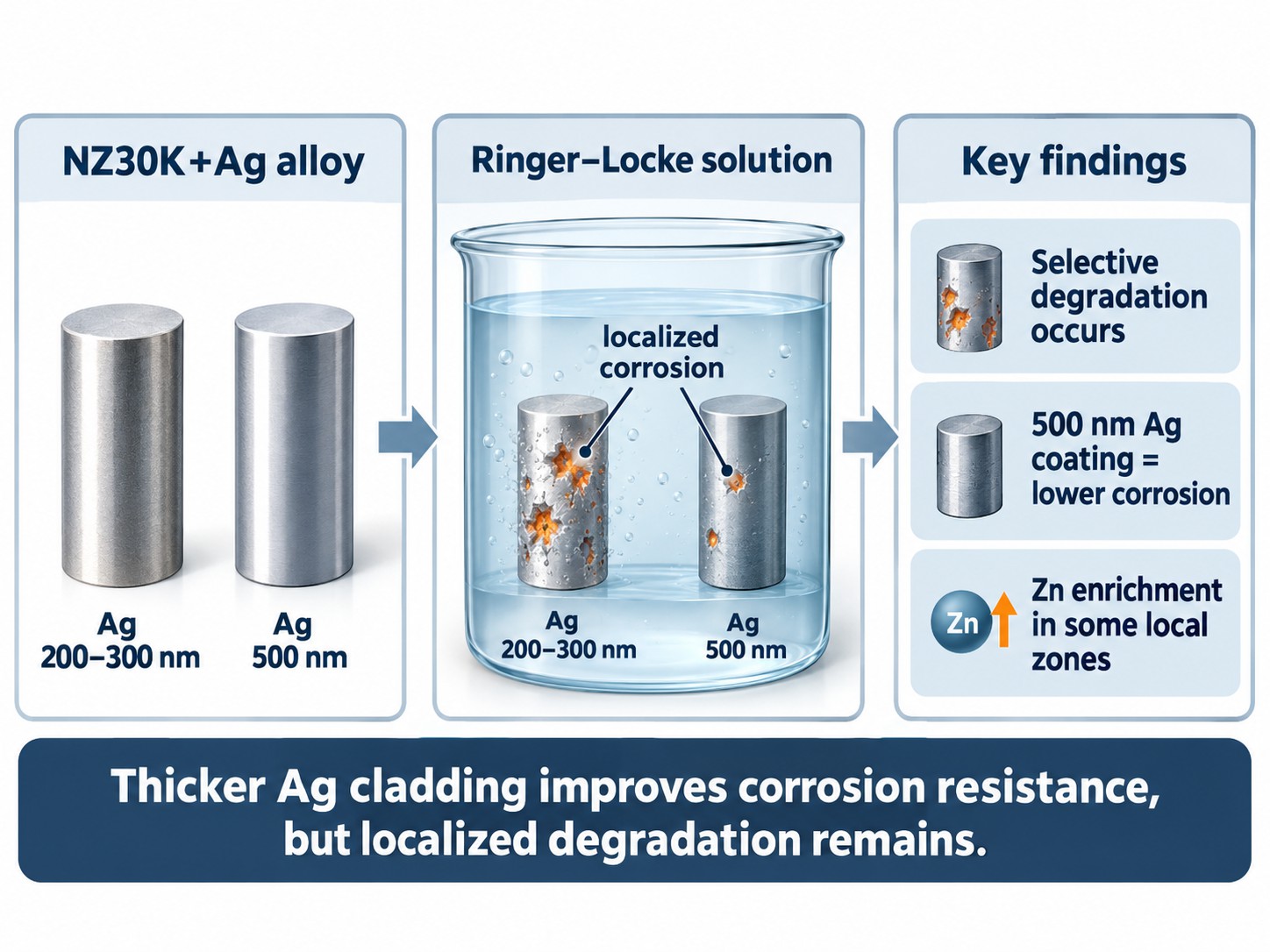
Biodegradable implants present significant challenges that hinder their widespread clinical application despite their potential benefits. Key issues include inconsistent degradation rates, insufficient mechanical strength, and the risk of inflammatory responses. These challenges must be addressed to enhance the efficacy and safety of biodegradable implants. This study focuses on the selective degradation behavior of a magnesium-zinc-zirconium-neodymium alloy coated with a silver layer of 200-300 and 500 nm in thickness. The material is proposed for manufacturing biodegradable implants intended for bone fracture treatment. According to the results of potential-dynamic studies of samples in the Ringer-Locke solution, it was found that its corrosion potential was -1.444 and -1.466 V, and the corrosion current density was 0.5012 and 0.3981 mA/cm2, respectively. The observed corrosion behavior of the studied samples is attributed to the distinctive characteristics of selective degradation occurring in areas of localized corrosion damage. It was shown that the surface of the corrosion damage of a sample with a coating thickness of 500 nm was enriched with zinc. For the sample with a 200-300 nm coating, the localized corrosion area also became enriched in zinc, while the remaining elements dissolved in the following sequence: magnesium, zirconium, silver, and neodymium.
References
Li, H., Zheng, Y., and Qin, L. (2014). Progress of biodegradable metals. Prog. Nat. Sci. Mater. Int., 24(5), 414–422. https://doi.org/10.1016/j.pnsc.2014.08.014 DOI: https://doi.org/10.1016/j.pnsc.2014.08.014
Cui, L.-Y., Li, X.-T., Zeng, R.-C., Li, S.-Q., Han, E.-H., & Song, L. (2017). In vitro corrosion of Mg–Ca alloy: The influence of glucose content. Frontiers of Materials Science, 11(3), 284–295. https://doi.org/10.1007/s11706-017-0391-y DOI: https://doi.org/10.1007/s11706-017-0391-y
Liu, Y., Yin, J., & Zhu, G. (2025). Advances in magnesium-based biomaterials: Strategies for enhanced corrosion resistance, mechanical performance, and biocompatibility. Crystals, 15(3), Article 256. https://doi.org/10.3390/cryst15030256 DOI: https://doi.org/10.3390/cryst15030256
Sharma, S. K., Gajević, S., Sharma, L. K., Pradhan, R., Miladinović, S., Ašonja, A., & Stojanović, B. (2024). Magnesium-Titanium Alloys: A Promising Solution for Biodegradable Biomedical Implants. Materials, 17(21), 5157. https://doi.org/10.3390/ma17215157 DOI: https://doi.org/10.3390/ma17215157
Saberi, A., Baltatu, M. S., & Vizureanu, P. (2024). Recent Advances in Magnesium–Magnesium Oxide Nanoparticle Composites for Biomedical Applications. Bioengineering, 11(5), 508. https://doi.org/10.3390/bioengineering11050508 DOI: https://doi.org/10.3390/bioengineering11050508
Sezer, N., Evis, Z., Kayhan, S. M., Tahmasebifar, A., & Koç, M. (2018). Review of magnesium-based biomaterials and their applications. Journal of Magnesium and Alloys, 6(1), 23–43. https://doi.org/10.1016/j.jma.2018.02.003 DOI: https://doi.org/10.1016/j.jma.2018.02.003
He, M., Chen, L., Yin, M., Xu, S., & Liang, Z. (2023). Review on magnesium and magnesium-based alloys as biomaterials for bone immobilization. Journal of Materials Research and Technology, 23, 4396–4419. https://doi.org/10.1016/j.jmrt.2023.02.037 DOI: https://doi.org/10.1016/j.jmrt.2023.02.037
Wang, H., Qiang, L., Mi, X., Wang, T., & Xu, X. (2023). Additive manufacturing of degradable magnesium alloys and their application in orthopedic implants. Digital Medicine, 9(3), Article e00008. https://doi.org/10.1097/DM-2023-00008 DOI: https://doi.org/10.1097/DM-2023-00008
Thirugnanasambandam, A., Mohankumar, A., Reddy Botta, R. P., Chong, W. W. F., Thangamani, G., & Gupta, M. (2024). Hydroxyapatite reinforced magnesium alloy composites using the ultrasonic-assisted rheo-squeeze casting technique: Microstructural and mechanical performance evaluation for bone fixture applications. Crystals, 14(7), Article 667. https://doi.org/10.3390/cryst14070667 DOI: https://doi.org/10.3390/cryst14070667
Muradov, A. D., Mukashev, K. M., Yar-Mukhamedova, G. S., & Korobova, N. E. (2017). Impact of silver metallization and electron irradiation on the mechanical deformation of polyimide films. Technical Physics, 62(11), 1692–1697. https://doi.org/10.1134/s1063784217110226 DOI: https://doi.org/10.1134/S1063784217110226
Sagyndykov, A. B., Kalkozova, Z. K., Yar-Mukhamedova, G. S., & Abdullin, K. A. (2017). Fabrication of nanostructured silicon surface using selective chemical etching. Technical Physics, 62(11), 1675–1678. https://doi.org/10.1134/s106378421711024x DOI: https://doi.org/10.1134/S106378421711024X
Wang, J., Zhang, Z., Zhang, Y., Jin, L., & Sheng, L. (2022). Experimental measurement on the phase equilibria of the Mg–Ag–Cu ternary system at 350 and 400 °C. Journal of Magnesium and Alloys, 10(2), 449–457. https://doi.org/10.1016/j.jma.2020.12.019 DOI: https://doi.org/10.1016/j.jma.2020.12.019
Yousefpour, F., Jamaati, R., & Aval, H. J. (2022). Synergistic effects of hybrid (HA+Ag) particles and friction stir processing in the design of a high-strength magnesium matrix bio-nano composite with an appropriate texture for biomedical applications. Journal of the Mechanical Behavior of Biomedical Materials, 125, Article 104983. https://doi.org/10.1016/j.jmbbm.2021.104983 DOI: https://doi.org/10.1016/j.jmbbm.2021.104983
Niwas, R., & Kumar, V. (2025). Synergic effect of nano sized ceramic powder of titanium dioxide and silver on AZ91D composites fabricated by friction stir processing. Ceramics International, 51(1), 1259–1270. https://doi.org/10.1016/j.ceramint.2024.11.106 DOI: https://doi.org/10.1016/j.ceramint.2024.11.106
Greshta, V., Shalomeev, V., Dzhus, A., & Mityaev, M. (2023). Study of the influence of silver alloying on the microstructure and properties of magnesium alloy NZ30K for implants in osteosynthesis. New Materials and Technologies in Metallurgy and Mechanical Engineering, (2), 14–19. https://doi.org/10.15588/1607-6885-2023-2-2 DOI: https://doi.org/10.15588/1607-6885-2023-2-2
Golovakha, M. L., Neryanov, Y. M., Ivchenko, D. V., & Kudievsky, A. V. (2016). General issues of traumatology and orthopedics: Study guide for practical classes (2nd ed.). Zaporizhzhia State Medical University.
Chowdeswarihalli Narayanappa, C., Nagappan, B., Vignesh, P., & Thirugnanasambandam, A. (2024). Enhancing biocompatibility and antibacterial activity of Mg/HA (magnesium-hydroxyapatite) composites with silver nanoparticles for orthopedic implant applications. Proceedings of the Institution of Mechanical Engineers, Part E: Journal of Process Mechanical Engineering, Article 09544089241281544. https://doi.org/10.1177/09544089241281544 DOI: https://doi.org/10.1177/09544089241281544
Feng, Y., Zhu, S., Wang, L., Chang, L., Hou, Y., & Guan, S. (2018). Fabrication and characterization of biodegradable Mg-Zn-Y-Nd-Ag alloy: Microstructure, mechanical properties, corrosion behavior and antibacterial activities. Bioact Mater. 3(3), 225-235. https://doi.org/10.1016/j.bioactmat.2018.02.002 DOI: https://doi.org/10.1016/j.bioactmat.2018.02.002
Greshta, V. L., Narivskyi, O., Dzhus, A., Vynar, V., Yar-Mukhamedova, G., Mukashev, K., Beissen, N., Mussabek, G., Imanbayeva, A.K., Zelele, D., Atchibayev, R., Kemelzhanova, A. (2024). Corrosion behavior of magnesium alloys NZ30K and NZ30K alloyed with silver in a model solution of the osteosynthesis process. Eurasian phys. tech. j., 21(3), 29–36. https://doi.org/10.31489/2024NO3/29-36 DOI: https://doi.org/10.31489/2024No3/29-36
Narivs’kyi, O. E. (2007). Influence of the heterogeneity of AISI-321 steel on its pitting in chloride-containing media. Materials Science, 43(2), 256–264. https://doi.org/10.1007/s11003-007-0029-9 DOI: https://doi.org/10.1007/s11003-007-0029-9
Narivs’kyi, O. E. (2023). Corrosion behavior of austenitic steels in chloride-containing media during the operation of plate-like heat exchangers. Physical Sciences and Technology, 10(2), Article 06. https://doi.org/10.26577/phst.2023.v10.i2.06 DOI: https://doi.org/10.26577/phst.2023.v10.i2.06
Yang, Z., Dong, H., Han, Y., Zhang, Y., Li, P., & Feng, Y. (2024). The growth behavior and mechanisms of pitting corrosion on super 13Cr martensitic stainless-steel surfaces at different diameter-to-depth ratios. Coatings, 14(4), Article 435. https://doi.org/10.3390/coatings14040435 DOI: https://doi.org/10.3390/coatings14040435
Zelele, D. M., Rutkowska-Gorczyca, M. (2024). Electrochemical synthesis and functional properties of metal and alloy-based composition coatings. Recent Contributions to Physics, 1(88), 41–48. https://doi.org/10.26577/RCPh.2024v88i1a06 DOI: https://doi.org/10.26577/RCPh.2024v88i1a06
Fritz, J. D., Pickering, H. W. (1991). Selective anodic dissolution of Cu–Au alloys: TEM and current transient study. Journal of the Electrochemical Society, 138(11), 3209–3218. https://doi.org/10.1149/1.2085394 DOI: https://doi.org/10.1149/1.2085394
Narivs’kyi, O.E. (2005). Corrosion fracture of platelike heat exchangers. Materials Science, 41(1), 122–128. https://doi.org/10.1007/s11003-005-0140-8 DOI: https://doi.org/10.1007/s11003-005-0140-8
Narivskyi, O.E., Belikov, S.B., Subbotin, S. A., Pulina, T.V. (2021). Influence of chloride-containing media on the pitting resistance of AISI 321 steel. Materials Science, 57(2), 291–297. https://doi.org/10.1007/s11003-021-00544-z DOI: https://doi.org/10.1007/s11003-021-00544-z
Pickering, H. W. (1983). Characteristic features of alloy polarization curves. Corrosion Science, 23(10), 1107–1120. https://doi.org/10.1016/0010-938x(83)90092-6 DOI: https://doi.org/10.1016/0010-938X(83)90092-6
Downloads
Published online
How to Cite
Issue
Section
License
Copyright (c) 2026 Eurasian Physical Technical Journal

This work is licensed under a Creative Commons Attribution-NonCommercial-NoDerivatives 4.0 International License.