The influence of thermostatting temperature on the ignition and deformation dynamics of a cylindrical charge in a nozzleless propulsion device
Authors
-
Leonid Leonidovich Minkov
 Doctor of Phys. - Math. Sciences, Professor, Mathematical Physics Department, Physics Engineering Faculty, Tomsk State University, Tomsk, Russian Federation
-
Nataliya Radikovna Gimayeva
Post graduate student, Physics Engineering Faculty, National Research Tomsk State University, Tomsk, Russian Federation
DOI:
https://doi.org/10.31489/2026N3/64-73Keywords:
nozzle less propulsion device, viscoelastic charge, ignition of the charge, coupled simulationAbstract
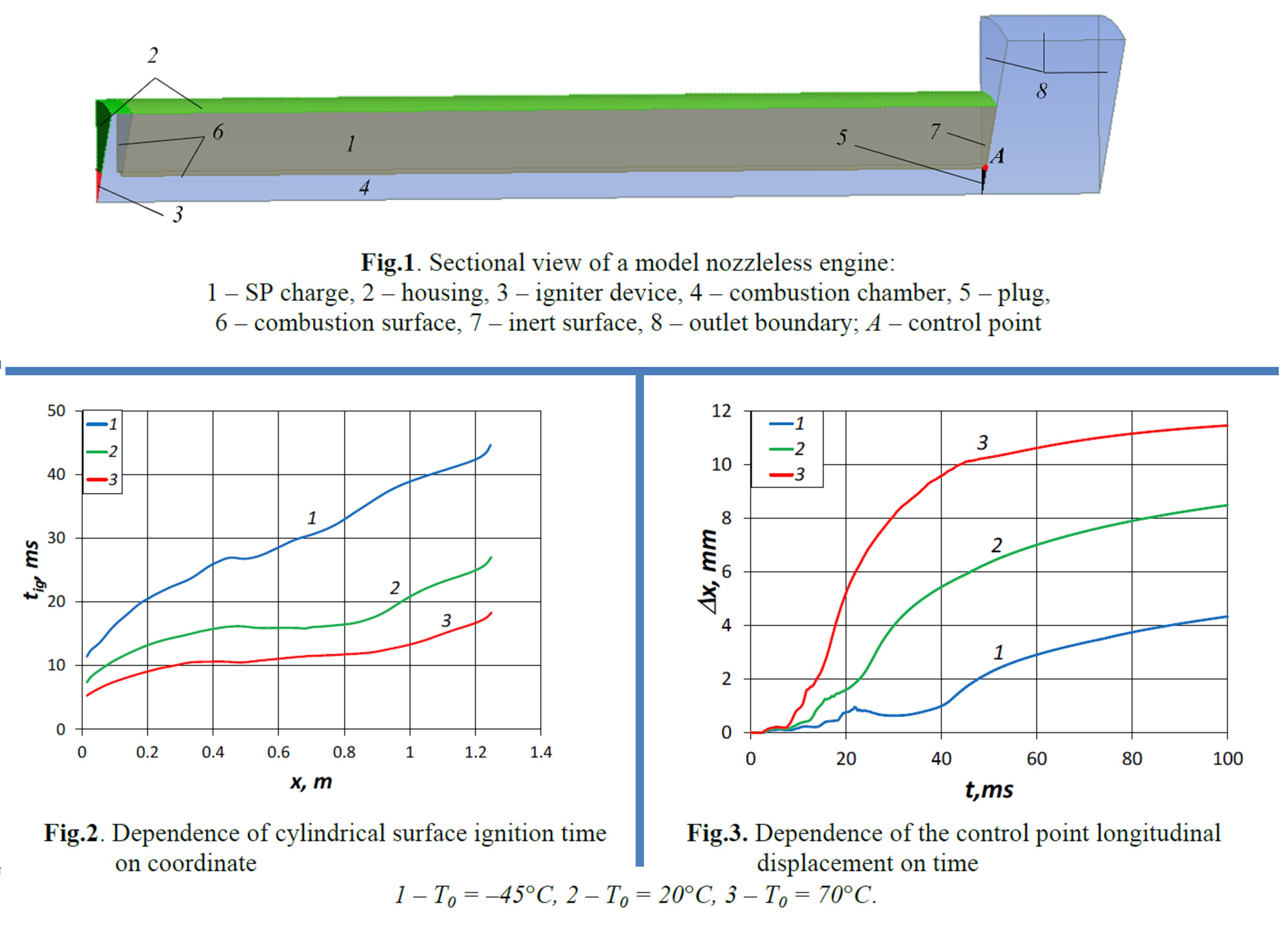
This article presents the results of numerical simulation of the steady-state operation of a nozzle less propulsion device (NPD) with a cylindrical viscoelastic solid propellant charge. The study was performed in a two-dimensional axisymmetric formulation, taking into account the coupled interaction of viscous compressible combustion products and a deformable charge. The viscoelastic behavior of the propellant is described using Prony series and the Williams-Landel-Ferry temperature-time shift function. It was found that an increase in the initial thermostatting temperature of the charge reduces its ignition time and decreases the initial shear modulus, which leads to a more than twofold increase in surface movement. It is shown that low initial temperatures lead to a decrease in propellant chamber pressure, while an increase in temperature by 115 °C increases the maximum pressure by 25 atm. The convergence of the numerical solution on three computational grids is assessed.
References
Yanovskiy, L.S., Ed., Aref’ev, K.Yu, Milyokhin, Yu. M., Sorokin, V.A., & Gusev, C.A. (2020). Ramjet engines on energy-intensive condensed materials. TsIAM, Moscow, 197 p. https://rusneb.ru/catalog/000199_000009_010495374/?ysclid= mu3r0sxm1i797515443 [in Russian]
Milyokhin, Yu.M., Burskly, G.V., Lavrov, G.S., Popov, V.S., & Sadovnichiy, D.N. (2018). Energetics and internal ballistics of solid rocket motors. Nauka, Moscow, 358 p. https://search.rsl.ru/ru/record/ 01009779112 [in Russian]
Minkov, L., & Gimayeva, N. (2024). Effect of Two-Phase Flow on the Fuel Grain Ignition and its Departure from the Cartridge Case. Eurasian Physical Technical Journal, 21, 1(47), 84–92. https://doi.org/10.31489/2024No1/84-92 DOI: https://doi.org/10.31489/2024No1/84-92
Gany, A., & Aharon, I. (2012). Internal Ballistics Considerations of Nozzleless Rocket Motors. Journal of Propulsion and Power, 15(6), 866–873. https://doi.org/10.2514/6.1995-2735 DOI: https://doi.org/10.2514/2.5509
Chyuan, S.W. (2003). Dynamic analysis of solid propellant grains subjected to ignition pressurization loading. Journal of Sound and Vibration, 268, 465–483. https://doi.org/10.17223/19988621/98/11 DOI: https://doi.org/10.1016/S0022-460X(02)01554-7
Min’kov, L.L., Gimaeva, N.R., & Dil’, D.V. (2025). Numerical study of the transition to a steady-state operating mode of a nozzleless propulsion system with a viscoelastic cylindrical charge. Vestnik Tomskogo gosudarstvennogo universiteta. Matematika i mekhanika, 98, 120–135. https://doi.org/10.17223/19988621/98/11 DOI: https://doi.org/10.17223/19988621/98/11
Li, Q., Liu, P., & He, G. (2015). Fluid–solid coupled simulation of the ignition transient of solid rocket motor. Acta Astronautica, 110, 180–190. https://doi.org/10.1016/j.actaastro.2015.01.020 DOI: https://doi.org/10.1016/j.actaastro.2015.01.017
Li, Y., Chen, X., Xu, J., Zhou, C., & Musa, O. (2018). Three-dimensional multi-physics coupled simulation of ignition transient in a dual pulse solid rocket motor. Acta Astronautica, 146, 46–65. https://doi.org/ DOI: https://doi.org/10.1016/j.actaastro.2018.01.058
Guo, X., Zhang, J.T., Zhang, M., Liu, L.S., Zhai, P.C., & Zhang, Q.J. (2016). Effects of liner properties on the stress and strain along liner/propellant interface in solid rocket motor. Aerospace Science and Technology, 58, 594–600. https://doi.org/10.1016/j.ast.2016.09.020 DOI: https://doi.org/10.1016/j.ast.2016.09.020
Marple, S.L., Jr. (1987). Digital spectral analysis: with applications. Prentice Hall, Englewood Cliffs, 492 p. https://openlibrary.org/books/OL2716295M/Digital_spectral_analysis
Williams, M.L., Landel, R.F., & Ferry, J.D. (1955). The Temperature Dependence of Relaxation Mechanisms in Amorphous Polymers and Other Glass-forming Liquids. Journal of the American Chemical Society, 77, 3701–3706. https://doi.org/10.1021/ja01619a008 DOI: https://doi.org/10.1021/ja01619a008
Minkov, L.L., Shrager, E.R., & Kiryushkin, A.E. (2016). Two approaches for simulating the burning surface in gas dynamics. Key Engineering Materials, 685, 114–118. https://doi.org/10.4028/www.scientific.net/KEM.685.114 DOI: https://doi.org/10.4028/www.scientific.net/KEM.685.114
Rashkovskiy, S.A., Milekhin, Y.M., & Fedorychev, A.V. (2016). Correlation of parameters in the burning rate law and its influence on intraballistic characteristics of a rocket motor. Combustion, Explosion, and Shock Waves, 52(4), 427-438. https://doi.org/10.1134/S0010508216040067 DOI: https://doi.org/10.1134/S0010508216040067
Goodman, Th.R. (1964). Application of Integral Methods to Transient Nonlinear Heat Transfer. Advances in Heat Transfer, 1, 51–122. https://doi.org/10.1016/S0065-2717(08)70097-2 DOI: https://doi.org/10.1016/S0065-2717(08)70097-2
Xu, J., Chen, X., Wang, H., Zheng, J., & Zhou, C. (2014). Thermo-damage-viscoelastic constitutive model of HTPB composite propellant. International Journal of Solids and Structures, 51, 3209–3217. https://doi.org/10.1016/j.ijsolstr.2014.05.024 DOI: https://doi.org/10.1016/j.ijsolstr.2014.05.024
Adel, W.M., & Liang, G.Z. (2017). Analysis of Mechanical Properties for AP/HTPB Solid Propellant under Different Loading Conditions. World Academy of Science, Engineering and Technology, 11(12), 1906–1910. https://doi.org/10.5281/zenodo.1314893
Milekhin, Y.M., Kluchnikov, A.N., Popov, V.S., & Pelipas, N.D. (2014). Calculation of the unsteady internal ballistic parameters of the transition of a solid rocket motor to steady-state operation using the method of characteristics. Combustion, Explosion, and Shock Waves, 50(6), 676-688. https://doi.org/10.1134/S0010508214060094 DOI: https://doi.org/10.1134/S0010508214060094
Downloads
Published online
How to Cite
Issue
Section
License
Copyright (c) 2026 Eurasian Physical Technical Journal

This work is licensed under a Creative Commons Attribution-NonCommercial-NoDerivatives 4.0 International License.