YOUNG STELLAR OBJECTS IN THE REGION OF DUST BUBBLE N22
Authors

DOI:
https://doi.org/10.31489/2026N2/130-138Keywords:
dust bubble, infrared radiation, young stellar objectsAbstract
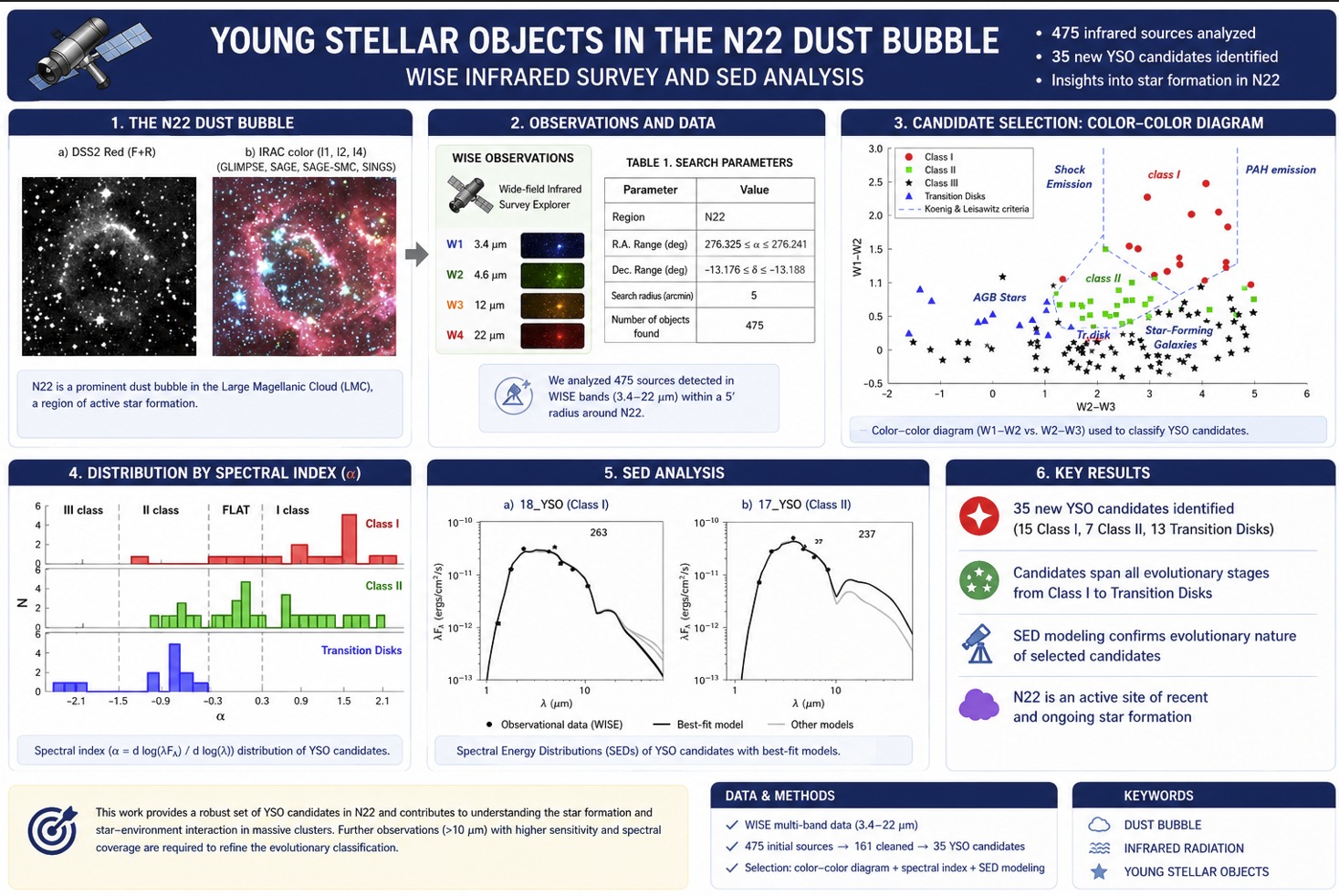
The study of young stellar objects is one of the priority areas in modern astrophysics, since these objects serve as key indicators of the processes accompanying the formation of stars and planetary systems. In the process of evolution, especially in the conditions of massive star clusters, they generate intense ultraviolet radiation and stellar winds that are capable to scatter the surrounding matter and forming expanding cavities that are infrared bubble structures in molecular clouds. The study of these structures allows us to obtain valuable information about the mechanisms of interaction of stars with their surrounding environment at various stages of evolutionary development. The aim of this work is to study the region of the dust bubble N22 in order to identify and classify young stellar objects. The main observational material was data obtained by the Wide-Field Infrared Survey Explorer space telescope in the near and mid-infrared range: W1 (3.4 μm), W2 (4.6 μm), W3 (12 μm), and W4 (22 μm). As a result of the analysis, new candidates for young stellar objects were identified within the studied region: 15 objects belonging to class I, 7 objects - class II, and 13 objects demonstrating the characteristics of transition disks. For all selected candidates for young stellar objects, color diagrams were constructed displaying their position relative to the characteristic regions of the evolutionary stages of young stars. In addition, spectral indices were calculated and the energy distribution in the spectrum was modeled, which confirmed the classification of objects by evolutionary stages.
References
1. Klessen, R.S., Glover, C. O. (2014). Physical Processes in the Interstellar Medium. Springer-Verlag Berlin Heidelberg, 191 p. https://arxiv.org/pdf/1412.5182
2. Assembay, Zh., Komesh, T., Garay, G., Omar, A., Esimbek, J., Alimgazinova, N.Sh., Kyzgarina, M.T., Murat, S. (2024). ALMA observations of the environments of G301.1364-00.2249A. Cosmic Masers: Proper Motion toward the Next-Generation Large Projects Proceedings IAU Symposium, 380, 3. https://doi.org/10.1017/S1743921323002624 DOI: https://doi.org/10.1017/S1743921323002624
3. Manapbaeva, A.B., Esimbek, J., Alimgazinova, N.Sh., Kyzgarina, M.T., Atamurat, A.B. (2021). N22 shan kopіrshіkterі zhanyndagy zhas zhuldyz obektіlerіn anyqtau. Izvestija Nacional'noj Akademii nauk Respubliki Kazahstan. Ser. Fiz-mat., 3(337), 96-105. https://journals.nauka-nanrk.kz/physics-mathematics/article/view/2078/2447 DOI: https://doi.org/10.32014/2021.2518-1726.51
4. Megeath, S. T., Allen, L. E., Gutermuth, R.A., Pipher, J.L., Myers, P.C., Calvet, N., Hartmann, L., Muzerolle, J., Fazio, J. (2004). Initial Results from the Spitzer Young Stellar Cluster Survey. The Astrophysical Journal Supplement Series, 154(1), 367. https://doi.org/10.1086/422823 DOI: https://doi.org/10.1086/422823
5. Gutermuth, R. A., Bourke, T.L., Allen, L.E., Myers, P.C., Megeath, S. T., Matthews, B.C., Jorgensen, J.K., Di Francesco, J., Ward-Thompson, D., Huard, T.L. (2008). The Spitzer Gould belt survey of large nearby interstellar clouds: discovery of a dense embedded cluster in the Serpens-Aquila Rift. The Astrophysical Journal, 673(2), L151. https://doi.org/10.1086/528710 DOI: https://doi.org/10.1086/528710
6. Robitaille, T.P., Meade, M.R., Babler, B.L., Whitney, B.A., Johnston, K.G., Indebetouw, R., Cohen, M., Povich, M.S., Sewilo, M., Benjamin, R.A., Churchwell, E. (2008). Intrinsically red sources observed by Spitzer in the Galactic midplane. The Astronomical Journal, 136, 2413-2440. https://doi.org/10.1088/0004-6256/136/6/2413 DOI: https://doi.org/10.1088/0004-6256/136/6/2413
7. Koenig, X. P., Leisawitz, D. V. (2014). A classification scheme for young stellar objects using the wide-field infrared survey explorer AllWISE catalog: revealing low-density star formation in the outer galaxy. The Astrophysical Journal, 791(2), 131. https://doi.org/10.1088/0004-637X/791/2/131 DOI: https://doi.org/10.1088/0004-637X/791/2/131
8. SIMBAD Astronomical Database - CDS (Strasbourg). https://simbad.cds.unistra.fr/simbad/sim-fcoo.
9. The VizieR Service for Astronomical Catalogues (CDS, Strasbourg, France). https://vizier.u-strasbg.fr/viz-bin/VizieR-3?-source=II/246&-out.max=50&-out.form=HTML%20Table&-form=sexa
10. AllWISE Source Catalog. https://irsa.ipac.caltech.edu/cgi-bin/Gator/nph-scan?mission=irsa&submit=Select &projshort=WISE
11. Churchwell, E., Povich, M.S., Allen, D., Taylor, M.G., Meade, M.R., Babler, B.L., Wolff, M.J. (2006). The Bubbling Galactic Disk. The Astrophysical Journal, 649 (2), 759-778. https://doi.org/10.1086/507015 DOI: https://doi.org/10.1086/507015
12. Kolpak, M.A., Jackson, J.M., Bania, T. M., Clemens, D. P., Dickey, J.M. (2003). Resolving the Kinematic Distance Ambiguity toward Galactic H II Regions. The Astrophysical Journal, 582 (2), 756. https://doi.org/10.1086/344752 DOI: https://doi.org/10.1086/344752
13. Simpson, R. J., Povich, M. S., Kendrew, S. (2012). The Milky Way Project First Data Release: A bubblier Galactic disc. Monthly Notices of the Royal Astronomical Society, 424(3), 2442–2460. https://doi.org/10.1111/j.1365-2966.2012.20770.x DOI: https://doi.org/10.1111/j.1365-2966.2012.20770.x
14. Alksnis, A., Balklavs, A., Dzervitis, U., Pundure, I. (2001). A general catalogue of galactic carbon stars by C.B. Stephenson. Third edition. VizieR Online Data Catalog. Baltic Astronomy, 10, 1-318. https://doi.org/10.1515/astro-2001-1-202 DOI: https://doi.org/10.1515/astro-2001-1-202
15. Koenig, X.P. (2012). Wide-field infrared survey explorer observations of the evolution of massive star-forming regions. The Astrophysical Journal, 744 (2),130. https://doi.org/10.1088/0004-637X/744/2/130 DOI: https://doi.org/10.1088/0004-637X/744/2/130
16. Turmaganbet, U., Zhexebay, D., Turlykozhayeva, D., Skabylov, A., Akhtanov, S., Temesheva, S., Masalim, P., Tao, M. (2025). Thermal infrared object detection with yolo models. Eurasian Physical Technical Journal, 22(2 (52), 121-132. https://doi.org/10.31489/2025N2/121-132 DOI: https://doi.org/10.31489/2025N2/121-132
17. Fischer, W. J. (2016). A WISE Census of Young Stellar Objects in Canis Major. The Astrophysical Journal, 827(2), 96. https://doi.org/10.3847/0004-637X/827/2/96 DOI: https://doi.org/10.3847/0004-637X/827/2/96
18. Verebélyi, E., Könyves, V., Nikolić, S., Kiss, C., Moór, A. (2013). Dense cores in the dark cloud complex LDN 1188. Astronomical Notes, 334, 924. https://doi.org/10.1002/asna.201311960 DOI: https://doi.org/10.1002/asna.201311959
19. Alimgazinova, N.Sh. (2025). Young stellar objects in the region of dust bubble N1. Recent Contributions to Physics, 92(1), 50–59. https://doi.org/10.26577/RCPh20259215 DOI: https://doi.org/10.26577/RCPh20259215
20. Komesh, T., Omar, A., Garay, G., Assembay, Zh., Alimgazinova, N.Sh., Zhumabay, N., Kyzgarina, M.T. (2021). ALMA observations of the environments of G333.0162+00.7615. Proceedings of the IAU, 17, S373, 35-38. . https://doi.org/10.1017/S1743921323000121 DOI: https://doi.org/10.1017/S1743921323000121
21. Watson, C., Povich, M.S. (2008). Infrared dust bubbles: probing the detailed structure and young massive stellar populations of galactic H II regions. The Astrophysical Journal, 681(2), 1341-1355. https://doi.org/10.1086/588005 DOI: https://doi.org/10.1086/588005
22. Kuhn, M.A., Souza, R.S. (2021). SPICY: the Spitzer/IRAC candidate YSO catalog for the inner Galactic midplane. The Astrophysical Journal Supplement Series, 254(33), 1-31. https://doi.org/10.3847/1538-4365/abe465 DOI: https://doi.org/10.3847/1538-4365/abe465
23. Ji, W.G., Zhou, J.J., Esimbek, J., Wu, Y.-F., Wu, G., Tang, X.-D. (2012). The infrared dust bubble N22: an expanding HII region and the star formation around it. Astronomy and Astrophysics, 544(A39),10. https://doi.org/10.1051/0004-6361/201218861 DOI: https://doi.org/10.1051/0004-6361/201218861
24. Cutri, R.M., Skrutskie, M.F. (2003). 2MASS All Sky Catalog of point sources. The IRSA 2MASS All-Sky Point Source Catalog. http://irsa.ipac.caltech.edu/applications/Gator/
25. Robitaille, T.P. (2017). A modular set of synthetic spectral energy distributions for young stellar objects. Astronomy & Astrophysics, 600(A11), 1-16. https://doi.org/10.1051/0004-6361/201425486 DOI: https://doi.org/10.1051/0004-6361/201425486
Downloads
Published online
How to Cite
Issue
Section
License

This work is licensed under a Creative Commons Attribution-NonCommercial-NoDerivatives 4.0 International License.