PROBING KING AND PLUMMER DARK MATTER MODELS USING ROTATION CURVES
Authors

DOI:
https://doi.org/10.31489/2026N2/139-147Keywords:
dark matter, spiral galaxies, rotation curves, King profile, Plummer profileAbstract
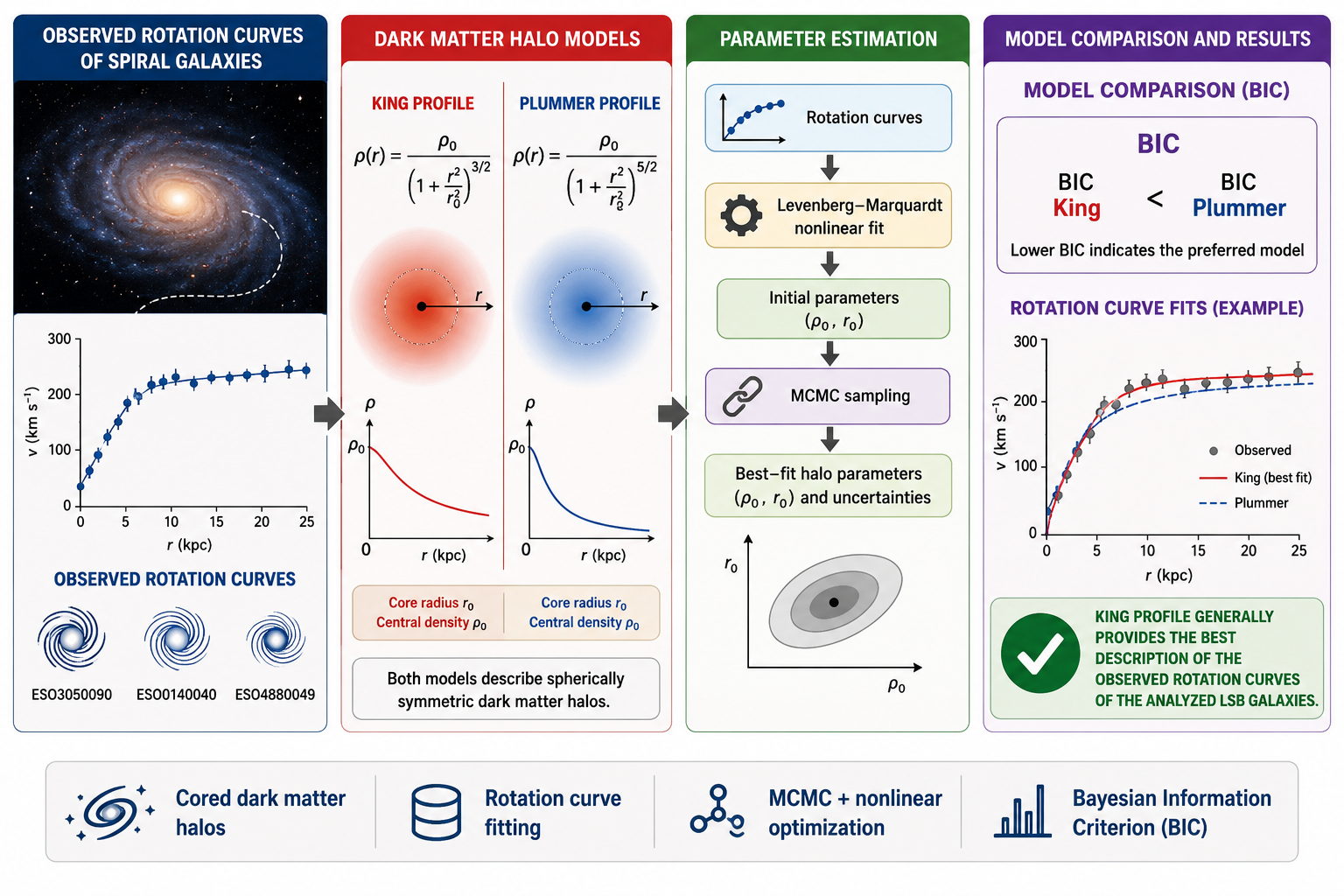
In this work, we study the distribution of dark matter in the halos of the spiral galaxies ESO3050090, ESO4880049, and ESO0140040 using their observed rotation curves. The analysis adopts spherically symmetric dark matter halos described by the King and Plummer density profiles, neglecting the baryonic component to emphasize the influence of the halo component only. As a first step, the characteristic halo parameters, the central density and the scale radius, are determined through a nonlinear least-squares fitting procedure based on the Levenberg–Marquardt algorithm. These best-fit values are then used as initial conditions for the Markov Chain Monte Carlo method to estimate the parameter space and uncertainties. Subsequently, we compare the results obtained from two specified fitting methods to assess their consistency and robustness. A statistical comparison between the King and Plummer profiles is performed using the Bayesian Information Criterion. The results of this work clarify how effectively the halo models under consideration reproduce the observed kinematics and highlight the ability to distinguish alternative dark matter density profiles.
References
1 Planck Collaboration (2020). Planck 2018 results. Astron. Astrophys. 641, A6, https://doi.org/10.1051/0004-6361/201833910, 1807.06209. DOI: https://doi.org/10.1051/0004-6361/202039265
2 Lake, G. (1989). Must the Disk and Halo Dark Matter Be Different? Astronomical Journal. 98, 1554, https://doi.org/10.1086/115238. DOI: https://doi.org/10.1086/115212
3 Lux, H., Read, J. I., Lake, G., Johnston, K. V. (2012). The Multidimensional Milky Way. Mon. Not. Roy. Astr. Soc., 424(1), L16–L20. https://doi.org/10.1111/j.1745- 3933.2012 DOI: https://doi.org/10.1111/j.1745-3933.2012.01276.x
4 Deason, A. J., Belokurov, V., Sanders, J. L. (2019). The total stellar halo mass of the Milky Way. Mon. Not. Roy. Astr. Soc., 490(3), 3426–3439. https://doi.org/10.1093/mnras/stz2793, 1908.02763. DOI: https://doi.org/10.1093/mnras/stz2793
5 de Blok, W. J. G. (2010). The Core-Cusp Problem. Advances in Astronomy, 789293, https://doi.org/10.1155/2010/789293, 0910.3538. DOI: https://doi.org/10.1155/2010/789293
6 Seo, G., Sohn, J., Lee, M. G. (2020). Tracing Dark Matter Halos with Satellite Kinematics and the Central Stellar Velocity Dispersion of Galaxies. Astrophys. J., 903(2), 130. https://doi.org/10.3847/1538-4357/abbd92, 2010.00693. DOI: https://doi.org/10.3847/1538-4357/abbd92
7 Rubin, V. C., Ford, Jr. W. K., Thonnard, N. (1980). Rotational properties of 21 SC galaxies with a large range of luminosities and radii, from NGC 4605 (R=4kpc) to UGC 2885 (R=122kpc). Astrophys. J., 238, 471–487. https://doi.org/10.1086/158003 DOI: https://doi.org/10.1086/158003
8 Volders, L. M. J. S. (1959). Neutral hydrogen in M 33 and M 101. Bulletin of the Astronomical Institutes of the Netherlands, 14, 323. https://scholarlypublications.universiteitleiden.nl/handle/1887/6267.
9 Freeman, K. C. (1970). On the Disks of Spiral and S0 Galaxies. Astrophys. J. 160, 811. https://doi.org/10.1086/150474 DOI: https://doi.org/10.1086/150474
10 Navarro, J. F., Frenk, C. S., White, S. D. M. (1996). The Structure of Cold Dark Matter Halos. Astrophys. J. 462, 563-575. https://doi.org/10.1086/177173 DOI: https://doi.org/10.1086/177173
11 Burkert, A. (1995). The Structure of Dark Matter Halos in Dwarf Galaxies. Astrophys. J. Lett. 447, L25–L28. https://doi.org/10.1086/309560, astro-ph/9504041. DOI: https://doi.org/10.1086/309560
12 Jimenez, R., Verde, L., Oh, S. P. (2003). Dark halo properties from rotation curves. Mon. Not. Roy. Astr. Soc., 339(1), 243–259. https://doi.org/10.1046/j.1365-8711.2003.06165.x DOI: https://doi.org/10.1046/j.1365-8711.2003.06165.x
13 Brownstein, J. R., Moffat, J. W. (2006). Galaxy Rotation Curves without Nonbaryonic Dark Matter. The Astrophysical Journal, 636(2), 721. https://doi.org/10.1086/498208. DOI: https://doi.org/10.1086/498208
14 Boshkayev, K., Konysbayev, T., Kurmanov, Y., Muccino, M., G. Z. (2020). Physical properties of dark matter in galaxy U11454. Physical Sciences and Technology, 10(3-4), 11–20. https://doi.org/10.26577/PHST.2020.V7.I2.02 DOI: https://doi.org/10.26577/phst.2020.v7.i2.02
15 Kurmanov, Y., Boshkayev, K., Konysbayev, T., Muccino, M., Urazalina, A., Ikhsan, G., Saiyp, N., Rabigulova, G., Karlinova, M., Suliyeva, G., Beissen, N. (2023). Analysis of dark matter profiles in the halos of spiral galaxies. Physical Sciences and Technology, 10(3-4), 4–16. https://doi.org/10.26577/PHST.2023.V10.I2.01 DOI: https://doi.org/10.26577/phst.2023.v10.i2.01
16 Boshkayev, K., Konysbayev, T., Kurmanov, E., Luongo, O., Muccino, M. (2020). Imprint of Pressure on Characteristic Dark Matter Profiles: The Case of ESO0140040. Galaxies, 8(4), 74. https://doi.org/10.3390/galaxies8040074. DOI: https://doi.org/10.3390/galaxies8040074
17 Boshkayev, K., Konysbayev, T., Kurmanov, Y., Luongo, O., Muccino, M., Quevedo, H., Zhumakhanova, G. (2024). Numerical analyses of M31 dark matter profiles. International Journal of Modern Physics D, 33, 2450016. https://doi.org/10.1142/S0218271824500160, 2212.02999. DOI: https://doi.org/10.1142/S0218271824500160
18 Boshkayev, K., Konysbayev, T., Kurmanov, E., Luongo, O., Malafarina, D., Mutalipova, K., Zhumakhanova, G. (2021). Effects of non-vanishing dark matter pressure in the Milky Way Galaxy. Mon. Not. Roy. Astr. Soc., 508(1), 1543–1554. https://doi.org/10.1093/mnras/stab2571, 2107.00138. DOI: https://doi.org/10.1093/mnras/stab2571
19 Suliyeva, G., Kurmanov, Y., Konysbayev, T., Boshkayev, K., Urazalina, A., Luongo, O. (2024). Finite temperature effects within scalar field dark matter model. Eurasian Physical Technical Journal, 21(2(48)), 92–101. https://doi.org/10.31489/2024No2/92-101. DOI: https://doi.org/10.31489/2024No2/92-101
20 de Blok, W. J. G., McGaugh, S. S., Rubin, V. C. (2001). High-Resolution Rotation Curves of Low Surface Brightness Galaxies. II. Mass Models. Astronomical Journal, 122(5), 2396–2427. https://doi.org/10.1086/323450. DOI: https://doi.org/10.1086/323450
21 Mannheim, P. D., O’Brien, J. G. (2012). Fitting galactic rotation curves with conformal gravity and a global quadratic potential. Phys. Rev. D, 85(12), 124020. https://doi.org/10.1103/PhysRevD.85.124020, 1011.3495. DOI: https://doi.org/10.1103/PhysRevD.85.124020
22 de Blok, W. J. G., Bosma, A. (2002). High-resolution rotation curves of low surface brightness galaxies. Astron. Astrophys., 385, 816–846. https://doi.org/10.1051/0004-6361:20020080. DOI: https://doi.org/10.1051/0004-6361:20020080
23 Barranco, J., Bernal, A., Nunez, D. (2015). Dark matter equation of state from rotational curves of galaxies. Mon. Not. Roy. Astr. Soc., 449(1), 403–413. https://doi.org/10.1093/mnras/stv302 DOI: https://doi.org/10.1093/mnras/stv302
24 King, I. (1962). The structure of star clusters. I. an empirical density law. Astronomical Journal, 67, 471. https://doi.org/10.1086/108756 DOI: https://doi.org/10.1086/108756
25 Plummer, H. C. (1911). On the problem of distribution in globular star clusters. Mon. Not. Roy. Astr. Soc., 71, 460–470. https://doi.org/10.1093/mnras/71.5.460. DOI: https://doi.org/10.1093/mnras/71.5.460
26 Fernandez-Hernandez, L. M., Rodrıguez-Meza, M. A., Matos, T. (2018). Comparison between two scalar field models using rotation curves of spiral galaxies. Journal of Physics Conference Series, 1010, 012005. https://doi.org/10.1088/1742-6596/1010/1/012005 DOI: https://doi.org/10.1088/1742-6596/1010/1/012005
27 Garcia-Aspeitia, M. A., Rodriguez-MezaM M. A. (2018). Constraining brane tension using rotation curves of galaxies. Journal of Physics Conference Series, 1010, 012006. https://doi.org/10.1088/1742-6596/1010/1/012006. DOI: https://doi.org/10.1088/1742-6596/1010/1/012006
28 Capistrano, A. J. S., Barrocas, G. R. G. (2018). Rotation curves of LSBGs and dwarf galaxies in a nearly Newtonian solution. Mon. Not. Roy. Astr. Soc., 475(2), 2204–2214. https://doi.org/10.1093/mnras/stx2909. DOI: https://doi.org/10.1093/mnras/stx2909
Downloads
Published online
How to Cite
Issue
Section
License

This work is licensed under a Creative Commons Attribution-NonCommercial-NoDerivatives 4.0 International License.