Photonics of benz [c, d] indole-based Polymethine Dyes molecules and singlet oxygen sensitization
Authors
-
Niyazbek Ibrayev
 Doctor of Physico-Mathematical Sciences, Professor, Institute of Molecular Nanophotonics, Buketov Karaganda National Research University, Karaganda, Kazakhstan
-
Gulnur Amanzholova
PhD, Senior Researcher, Institute of Molecular Nanophotonics, Buketov Karaganda National Research University, Karaganda, Kazakhstan
-
Amina Aymagambetova
Master, Junior Researcher, Institute of Molecular Nanophotonics, Buketov Karaganda National Research University, Karaganda, Kazakhstan
DOI:
https://doi.org/10.31489/2026N3/37-43Keywords:
benz[c, d]indole, polymethine dyes, intersystem crossing, triplet state, singlet oxygen, photodynamic therapyAbstract
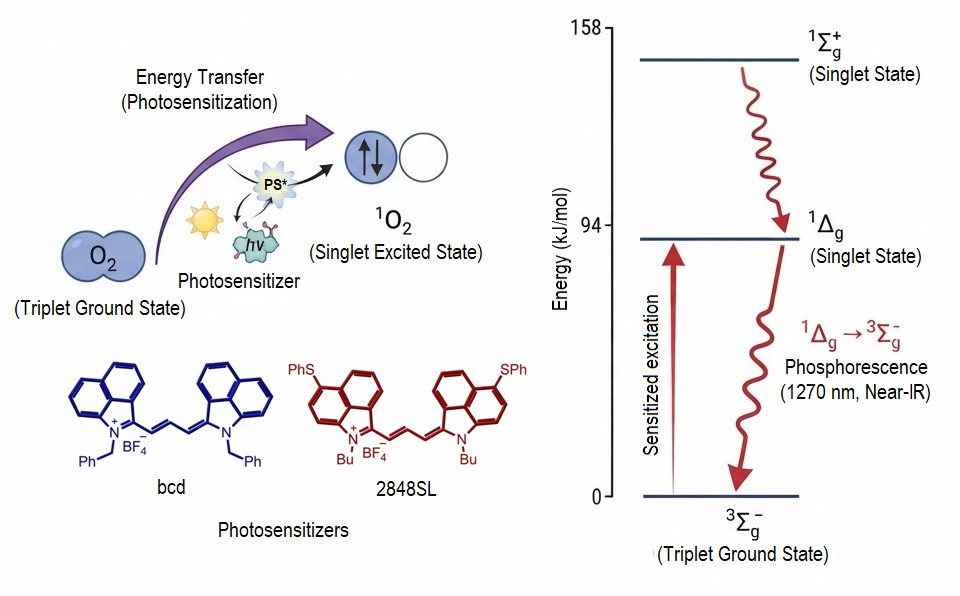
This study presents a comparative study of the photophysical properties of the basic polymethine dye bcd based on benz[c,d]indole and its modified derivative 2848SL. Replacing the phenyl groups (Ph) at the nitrogen atoms with butyl radicals (Bu), as well as introducing phenylmercapto groups (-SPh) into the 2848SL molecule, improves electron conjugation, resulting in a bathochromic shift of the absorption and fluorescence maxima to the near-IR region. This modification was found to increase the lifetime of the triplet state from 21.1 to 33.2 μs and leads to an increase of the quantum yield of singlet oxygen generation O2(1∆g) to 0.10. The obtained results confirm the effectiveness of triplet-triplet energy transfer, making the 2848SL derivative a promising agent for photodynamic therapy.
References
Bricks, J.L., Kachkovskii, A.D., Slominskii, Yu.L., et al. (2015). Molecular design of near infrared polymethine dyes: A review. Dyes and Pigments, 121, 238–255. https://doi.org/10.1016/j.dyepig.2015.05.016 DOI: https://doi.org/10.1016/j.dyepig.2015.05.016
Dereje, D.M., Pontremoli, C., Moran Plata, M.J., et al. (2022). Polymethine dyes for PDT: recent advances and perspectives to drive future applications. Photodiagnosis and Photodynamic Therapy, 21, 397-419. https://doi.org/10.1007/s43630-022-00175-6 DOI: https://doi.org/10.1007/s43630-022-00175-6
Ishchenko, A.A., & Syniugina, A.T. (2023). Structure and photosensitizer ability of polymethine dyes in photodynamic therapy: A review. Theoretical and Experimental Chemistry, 58(6), 373–401. https://doi.org/10.1007/s11237-023-09754-9 DOI: https://doi.org/10.1007/s11237-023-09754-9
Polishchuk, V., Filatova, M., Rusanov, E., et al. (2022). Trianionic 1,3,2‑Dioxaborine‑ Containing Polymethines: Bright Near‑Infrared Fluorophores. Chemistry – A European Journal, 28(70), e202202168. https://doi.org/10.1002/chem.202202168 DOI: https://doi.org/10.1002/chem.202202168
Tolmachev, A.I., Slominskii, Yu.L., & Ishchenko, A.A. (1998). New cyanine dyes absorbing in the NIR region. New Infrared Dyes for High Technology Applications.NATO ASI Series.3. High Technology, 52, 385-415. https://doi.org/10.1007/978-94-011-5102-3_19 DOI: https://doi.org/10.1007/978-94-011-5102-3_19
Ishchenko, A. A., Derevyanko, N. A., Zubarovskii, V. M., et al. (1985). Influence of length of the polymethine chain on width of absorption bands of symmetric cyanine dyes.Theoretical and Experimental Chemistry, 20(4), 415-422. https://doi.org/10.1007/BF00516576 DOI: https://doi.org/10.1007/BF00516576
Derevyanko, N.A., Ishchenko, A.A., & Kulinich, A.V. (2020). Deeply coloured and highly fluorescent dipolar merocyanines based on tricyanofuran. Physical Chemistry Chemical Physics, 22(5), 2748-2762. https://doi.org/10.1039/C9CP05827C DOI: https://doi.org/10.1039/C9CP05827C
Drexhage, K. H. (1976). Fluorescence Efficiency of Laser Dyes. Journal of Research of the National Bureau of Standards – A. Physics and Chemistry, 80A(3), 421-428. https://doi.org/10.6028/jres.080A.044 DOI: https://doi.org/10.6028/jres.080A.044
Voiciuk, V., Redeckas, K., Derevyanko, N.A., et al. (2014). Study of photophysical properties of a series of polymethine dyes by femtosecond laser photolysis. Dyes and Pigments, 109, 120–126. https://doi.org/10.1016/j.dyepig.2014.05.012 DOI: https://doi.org/10.1016/j.dyepig.2014.05.012
Kulinich, A.V., Ishchenko, A.A., Chibisov, A.K., et al. (2014). Effect of electronic asymmetry and the polymethine chain length on photoprocesses in merocyanine dyes. Journal of Photochemistry and Photobiology A: Chemistry, 274, 91-97. https://doi.org/10.1016/j.jphotochem.2013.09.016 DOI: https://doi.org/10.1016/j.jphotochem.2013.09.016
Redeckas, K., Voiciuk, V., Ishchenko, A.A., et al. (2018). Dark states of symmetric polymethine dyes revealed by pump–dump–probe spectroscopy. Lithuanian Journal of Physics, 58(4), 346-357. https://doi.org/10.3952/physics.v58i4.3879 DOI: https://doi.org/10.3952/physics.v58i4.3879
Ishchenko, A.A., Kurdyukova, I.V., Bogdanovich, M.V., et al. (2021). Electronic structure and spectral-fluorescent properties of thiopyrylo-4-tricarbocyanine laser dyes. Optics and Spectroscopy, 129(8), 926-934. https://doi.org/10.1134/S0030400X21070080 DOI: https://doi.org/10.1134/S0030400X21070080
Rüttger, F., Mindt, S., Golz, C., et al. (2019). Isomerization and dimerization of indocyanine green and a related heptamethine dye. European Journal of Organic Chemistry, 2019(30), 4791-4796. https://doi.org/10.1002/ejoc.201900715 DOI: https://doi.org/10.1002/ejoc.201900715
Bregnhøj, M., & Ogilby, P.R. (2026). Quantum yield standards for the photosensitized production of singlet oxygen in water. Physical Chemistry Chemical Physics, 28(26), 15768-15790. https://doi.org/10.1039/D6CP01739H DOI: https://doi.org/10.1039/D6CP01739H
Szewczyk, G., & Mokrzyński, K. (2025). Concentration-dependent photoproduction of singlet oxygen by common photosensitizers. Molecules, 30 (5), 1130. https://doi.org/10.3390/molecules30051130 DOI: https://doi.org/10.3390/molecules30051130
Wilkinson, F., Helman, W.P., & Ross, A.B. (1993). Quantum Yields for the Photosensitized Formation of the Lowest Electronically Excited Singlet State of Molecular Oxygen in Solution. Journal of Physical and Chemical Reference Data 22(1), 113-262. https://doi.org/10.1063/1.555934 DOI: https://doi.org/10.1063/1.555934
OriginLab Corporation, Originpro 8.0; Originlab Corporation, Northampton, MA, USA, 2007.
Ishchenko, A.A. (1994). Structure and Spectral-Luminescent Properties of Polymethine Dyes [in Russian]. Kyiv: Naukova Dumka, 232 p.
Henary, M., Paranjpe, S., & Owens, E.A. (2013). Synthesis and applications of benzothiazole containing cyanine dyes. Heterocyclic Communications, 19 (2), 1-11. https://doi.org/10.1515/hc-2013-0012 DOI: https://doi.org/10.1515/hc-2013-0012
Kanofsky, J. R., & Sima, P. D. (2000). Structural and environmental requirements for quenching of singlet oxygen by cyanine dyes. Photochemistry and Photobiology, 71(4), 361-368. https://doi.org/10.1562/0031-8655(2000)0710361SAERFQ2.0.CO2 DOI: https://doi.org/10.1562/0031-8655(2000)071<0361:SAERFQ>2.0.CO;2
Downloads
Published online
How to Cite
Issue
Section
License
Copyright (c) 2026 Eurasian Physical Technical Journal

This work is licensed under a Creative Commons Attribution-NonCommercial-NoDerivatives 4.0 International License.